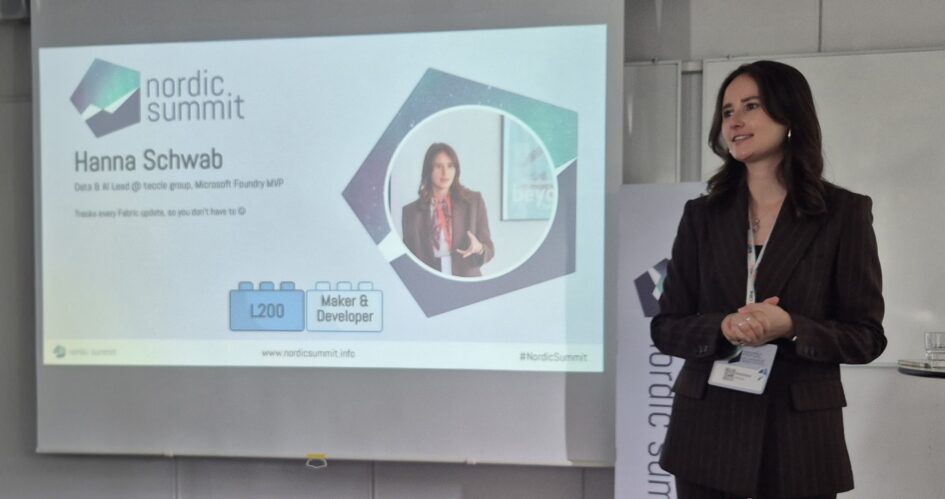
One of the 20-minute overview slots on day two of Nordic Summit 2026 went to Hanna Schwab on Microsoft Fabric updates worth paying attention to. Hanna leads the data and analytics team at teccle group, a German consulting company, and picked two updates out of the monthly hundreds: Fabric IQ with ontologies, and Fabric data agents as MCP servers. She also brought a real client case, which is what made the session worth writing up. This is my recap. The examples are hers, the summary and any mistakes are mine.
A sticker for each update
Her framing was practical: the monthly Fabric update page has hundreds of entries, and the useful question is not what is new but what you should do about each one. So each update in her deck carried a label: use it because there is clear business value, try it but note it is still in preview, or watch and wait and prioritise something else.
Fabric IQ and ontologies
Fabric IQ adds what she called a semantic intelligence layer on top of the data: business context, a common business language, and crucially the named relationships between things. Semantic models already let you connect tables. What was missing was a shared understanding of what the data means, in words a business uses.
The payoff is for agents. Before Fabric IQ, an agent had to work out what the data meant, which in her experience meant a lot of prompt engineering. With an ontology in place, that context is already there: the agent does not have to be fed a long prompt of explanation before answering, the answers get better, and the silos that survive every data consolidation project get a common vocabulary at last. She had tested it herself and said the added context measurably improved her agents’ answers.
Her sticker for it was the honest one: discover it, but it is still in preview and not production-ready in her view. Keep an eye on it, because Fabric IQ is part of the Microsoft IQ family alongside Work IQ, Foundry IQ and Web IQ, and Microsoft is pushing that family hard.
Fabric data agents as MCP servers
The second update was the one with immediate use: when you publish a Fabric data agent, it becomes an MCP server exposing a single tool, which you can connect to Copilot Studio, Foundry, VS Code agent mode or your own client. She showed it in Copilot Studio, where the Fabric IQ MCP appears under tools and the data is simply there, ready for a sales agent or a multi-agent workflow.
The client case: four million electrical products
The best part was a real project. Her client, an umbrella organisation for German electrical wholesalers, has 45 wholesalers in Germany, an international network of around 200, and roughly four million products in a German data pool. Their goal is centralised master data management for independent companies so that the umbrella organisation can support them with marketing, sales and logistics.
The obstacle was the one anyone who has worked with wholesale data will recognise: price lists and item descriptions from different suppliers, all in different formats, with tables and columns that mean different things. You cannot build synergies on that without a shared language first.
So they built an ontology in Fabric IQ. The graph has entities for product, manufacturer, price and classification, and the relationships between them are named: manufacturers have products, products have logistics, products have classifications. Simple, and it scales. You do not have to build it by hand either: you can work from OneLake data directly, or auto-generate an ontology from an existing semantic model and correct it afterwards, which she said did most of the work for her.
Then she put a data agent on top and asked it three questions of increasing difficulty. Give me information about product XYZ: trivial, no context needed, and a reminder that the agent writes the query so nobody needs SQL or DAX. Add price and product information and prepare an offer for five pieces: still straightforward, running against the silver lakehouse tables. And then the one that needed the ontology: find me a compact, long-lasting, warm LED downlight with these specifications, compare the options and recommend one.
Nothing in that last request is quantifiable. Compact, long-lasting and warm are not columns. The agent produced a comparison and a recommendation because the ontology told it what those words mean for these products. The project is not in production yet, and they are getting there step by step.
What to do on Monday
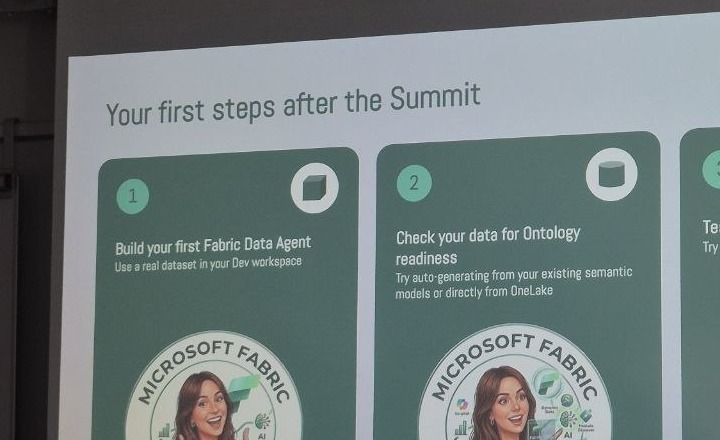
Her recommendations in order. Try Fabric data agents, because they work well today and integrate with Microsoft 365 Copilot, Copilot Studio, Foundry and your own applications. Keep an eye on ontologies and Fabric IQ, because Microsoft is investing heavily and it will be a large theme at Ignite. And test the MCP integration, which she thinks has more impact on everyday work than its size suggests.
Short and sweet, as she put it, and she stayed for questions through the break.