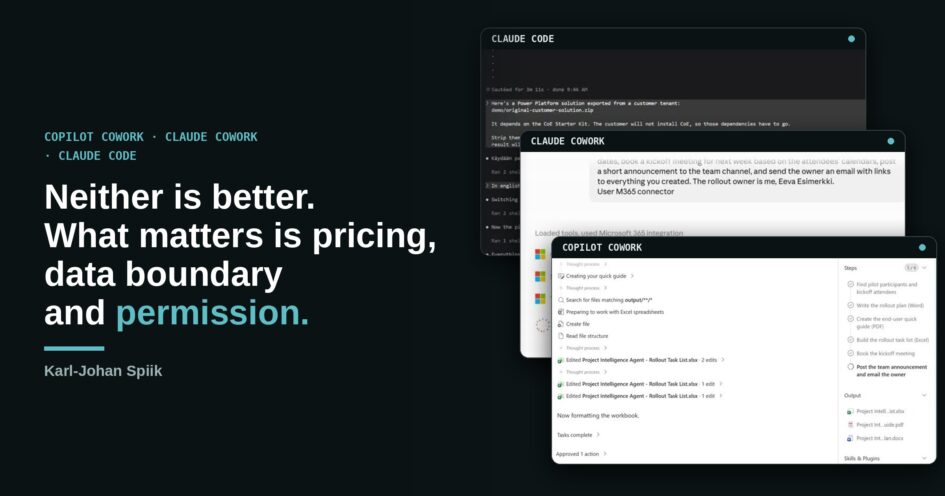
Most comparisons of AI tools ask which one is smartest or latest. In my daily M365 and Power Platform work that is almost never what decides it. What decides it is where the agent runs and whose rights it uses. In this post there are five tables are from my talk at The AI-Native Workplace Summit 2026 on 16 September, exactly as they were on the slides. Nothing here wins. In the colour tables, Yes, Partly and No replace the green, amber and red dots.
Three different kinds of colleague
| Copilot Cowork | Claude Cowork | Claude Code | |
|---|---|---|---|
| Where it runs | Microsoft 365 tenant | Desktop browser session | Local terminal |
| Identity | Your tenant identity | Your browser identity | Local user and tokens |
| Governance and audit trail | Native tenant controls | Browser and service controls | Repository and toolchain controls |
| Strength | Permission-scoped tenant work | UI work without APIs | Repeatable file-level change |
| What it cannot do | Cross blocked boundaries | Bypass policy decisions | Invent missing permissions |
| Best fit | Tenant knowledge work | Closed or absent APIs | Reviewable bulk change |
Read the first two rows and the rest of the table follows. Copilot Cowork runs inside the tenant as you, so it inherits your permissions, your DLP and your audit log without anyone configuring them for it. Claude Cowork runs in your browser session, so it can reach anything you can click, including services with no API, but it carries only the rights that session already has. Claude Code runs where the files are, with its own identity, so it can repeat a change and show a diff, but it is outside the tenant and cannot be granted a permission by wishing. The row “what it cannot do” is the same sentence three times in different words: none of them gets past a permission it was not given.
What each one can actually do
| M365 Copilot | Copilot Cowork | Copilot Studio | Claude Code | Claude Cowork | Claude Chrome | |
|---|---|---|---|---|---|---|
| Answer from tenant content | Yes | Yes | Yes | No | No | No |
| Permission-scoped by design | Yes | Yes | Yes | No | No | No |
| Click through a browser UI | No | Yes | Partly | No | Yes | Yes |
| Edit files and run commands | No | Yes | Partly | Yes | Yes | Partly |
| Build Power Platform solutions | No | No | No | Yes | Partly | Partly |
| Scheduled run, machine off | Yes | Yes | Yes | Partly | Yes | No |
| Event or API trigger | No | Yes | Yes | Partly | Yes | No |
| Output you can version and review | No | No | Partly | Yes | Partly | No |
The table splits down the middle. The three Microsoft tools answer from tenant content with the user’s own permissions, and the three Claude tools do not, because they are not in the tenant. The Claude tools edit files and produce output you can version and review, and the Microsoft tools mostly do not, because their work happens inside a service rather than in files you hold. Two rows are the ones people argue about. Building Power Platform solutions is a Yes only for Claude Code, and that includes Copilot Studio getting a No, because it runs an agent rather than producing solution artefacts you can build from. Clicking through a browser UI is a Yes for both Coworks and Claude Chrome, and only Partly for Copilot Studio, whose computer use follows a path defined in advance while the others work the path out as they go.
Where the data goes
| Runs | Identity | Data leaves tenant | Audit trail | |
|---|---|---|---|---|
| M365 Copilot | In tenant | User | No | Purview |
| Copilot Cowork | In tenant | User | No | Purview |
| Copilot Studio | In tenant | Agent / user | Partly | Purview + DLP |
| Claude Cowork | Workstation | Browser session | Yes | What you log |
| Claude Code | Server | Own | Yes | What you log |
| Claude Chrome | Browser | Browser session | Yes | What you log |
This is the table a security review stops at, and it should. The bottom three rows say the data leaves the tenant and the audit trail is whatever you build yourself. That is not a verdict, it is a fact to design around: build in a separate tenant, review the result, then move it to the customer, and the question never arises. The identity column hides a second difference. The Microsoft tools act as the user, so their answers are already scoped to what that person may see. Claude Code has its own identity. You can give it tenant access with an app registration, but then it sees everything, and an answer about what a person can reach becomes an answer about what an application can reach.
What it costs at light and heavy use
| Licence model | Light use (25%) | Heavy use (100%) | |
|---|---|---|---|
| M365 Copilot | Fixed, $30/user/mo | $30 | $30 |
| Copilot Cowork | Metered, $0.01/credit | about $53 + licence | about $210 + licence |
| Copilot Studio | $200 = 25 000 credits | pay per use | capacity pack |
| Claude Pro | Fixed, $20/mo | $20 | hits limits |
| Claude Max 5x | Fixed, $100/mo | $100 | $100 |
| Claude Max 20x | Fixed, $200/mo | $200 | $200 |
| Claude Code | Included in every paid plan | included | included |
The comparison here is between two pricing models, not between two numbers. A fixed licence costs the same at 25 percent and at 100 percent. A metered one quadruples, and credits bill building and testing as well as running. The Cowork figures are a worked example, 5 versus 20 agent tasks a working day at roughly 50 credits each, not a measurement. Claude’s side fails in the opposite direction: the cheap tier hits its limits, and the flat tiers above it stay flat. Neither model is better. Know which direction your usage points before you pick.
Choosing between the three
| Situation | Tool | Why |
|---|---|---|
| Who can actually reach this content? | Copilot Cowork | Permission-scoped tenant identity |
| A lightweight internal app, fast | Copilot Cowork | App Builder (Frontier), not Power Apps |
| No API, or API closed | Claude Cowork | Uses the existing browser session |
| One-off work, not repeated | Claude Cowork | Fastest path through the UI |
| Same change in 58 places | Claude Code | Scripted, repeatable file edits |
| This must be reviewable | Claude Code | Diffable artifacts and checks |
| Get an idea testable tonight | Any of the three | Choose by access and artifact |
Every row of the last table is decided by the first table. Permission-scoped identity is a place, not a feature, so questions about who can reach what go to the tool that stands in the tenant. A closed API is a boundary, so the work goes to the tool that stands in your browser session and does not need one. Repeatable and reviewable are properties of files, so that work goes to the tool that stands in the files. The question is not which of the three is better. It is whether your problem has boundaries you already know, or a route you do not know yet.