European Power Platform Conference, Copenhagen | Thursday, July 1, 2026 | Inspire Stage
Most sessions at a technical conference teach you something to implement on Monday morning. This one asked you to look at yourself first — who you are, how you work, and whether the way organisations are built actually lets people like you function at their best.
Karl-Johan Spiik — Senior Consultant at CGI, Microsoft MVP, and author of five books on community-led leadership — opened his Inspire Stage session with a confession and a fire story. The confession: he has ADHD and Asperger’s, so public speaking is not his comfort zone. The fire story is where the session started making sense.
The Barn Fire
A week and a half before EPPC, Karl was at a summer cabin in Finland when a neighbour’s wooden barn caught fire. Four hours of heating a sauna had set the old, dry building alight. Karl and his friends ran over. One friend had asthma, so Karl climbed a ladder to the attic door — and stopped before opening it fully. He cracked it, saw flames in the corner, and shouted that they were in a hurry. Someone handed him the hose. He shot the fire down. They rotated, checked the whole building inside and out, called the fire department. By the time the boat arrived, the fire was out. The thermal camera showed nothing left.
Nobody waited for instructions. Nobody appointed a leader. They read the situation, distributed the work, acted — and it worked.
“We didn’t have time to wait for instructions from the manager. We just acted.”
Karl’s point wasn’t about heroics. It was about what happens when a team of people who know and trust each other faces a crisis. They respond like children — spontaneous, instinctive, fast — but not chaotic. Knowing how to act without being told is not the same as anarchy. That distinction is at the heart of community-led leadership. And it is, he argued, exactly the disposition we need as AI agent development accelerates around us.
Who This Talk Was For
Karl was explicit: this session had two audiences.
For neurotypical people: an invitation to understand how neurodiverse colleagues experience the world — not to fix them, but to extend some empathy when someone isn’t smiling back on cue or isn’t navigating the social choreography of a meeting naturally.
For neurodiverse people: permission to stop masking. Masking — the habit of wearing a social face that doesn’t reflect what you actually feel — is exhausting. Every smile that isn’t genuine, every forced response, every adaptation to a neurotypical norm drains energy. Karl learned the word itself only about six months before this talk. Understanding the pattern doesn’t fix it overnight, but naming it is the beginning.
His caution: don’t turn this into an us-versus-them framing. Neurotypical people aren’t bad. They’re just different. He’d seen teams destroyed by internal tribalism — people dividing into factions, competing, protecting territory. “Thinking like us versus them is very harmful thinking.”
AI Is Mimicking Brains Like Ours
Karl’s background is 19 years of Microsoft project delivery, eight years with Power Platform, three with AI — and now agentic development with Claude Code. He sees a specific pattern in how neurodiverse people relate to AI.
The technical insight: AI neural networks are modelled on the synapses in human brains. Neurodiverse people — particularly those with autism or ADHD — often have more of these synaptic connections. A bigger machine to run, but one that, if left untrained and uncontrolled, produces chaos.
The parallel: AI models without guardrails produce chaos too. Control and structure aren’t constraints on capability — they’re what makes capability usable.
For Karl personally, structure is a daily practice. He wakes at six, does morning yoga, drinks coffee in the bathtub, ends his shower with a minute of cold water, and keeps his phone away for the first two hours of the day. His dopamine levels don’t stabilise well on their own — so he manages the environment instead. He even built a Power Automate flow that starts his Spotify automatically so he doesn’t have to open his phone to choose music.
“If you haven’t trained your mind, haven’t learned who you are and how your body and mind works — then you can’t handle changes.”
The Leadership Model
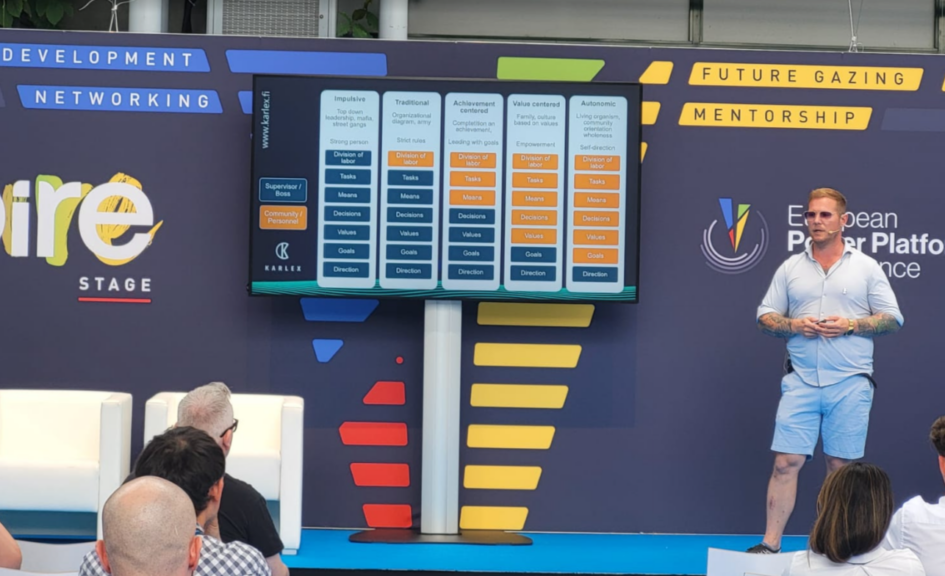
Karl’s five books on community-led leadership are built around a model he developed by analogy with the IaaS/PaaS/SaaS diagram. He saw that picture, liked how it structured layers of control, and made his own version for leadership styles — mapping six dimensions (division of labour, tasks, means, decisions, values, goals) from full top-down control to full community ownership.
Impulsive — the street gang or mafia model. The boss controls everything, from how work is divided to what the organisation values. Extreme micromanagement. Survives on fear.
Traditional — the army model. Strict rules, defined roles, clear hierarchy. Works well in high-stakes, low-variation environments (a factory making ten thousand identical cans a day has no need for creative autonomy).
Achievement — where most organisations in the world currently sit. Leaders set goals; teams figure out tasks and means. But the boss still wants to make the key decisions.
Servant — the shift happens when a leader realises: why should I make this decision? The specialist doing the work every day has better information. The leader’s job becomes serving the team, not directing it. Decisions come from the people doing the work.
Organic — fully self-organising. No management layer between a CEO and self-organising teams. Karl worked in a company structured this way in 2020. It was outstanding — and it has its own challenges.
The most important thing Karl said about this framework: there’s no wrong leadership style, only wrong fit. An impulsive structure in a mafia makes sense. The same structure in a software team kills it. The problem isn’t the style — it’s applying a style that doesn’t match what the situation and the people need. And if the leader never asks the team what kind of leadership they want, people will experience any mismatch as bad leadership, even if the style is internally consistent.
AI Changes Who Needs Leadership Skills
Here is the thread that connects leadership theory to AI:
Previously, tools didn’t talk back. A hammer doesn’t reply. But AI does — it’s communication. When you prompt an AI agent, you are giving it direction, setting context, correcting it, assigning it work. You are, functionally, leading it.
Karl’s conclusion: every person now needs leadership skills. These were once the domain of managers and team leads — how to delegate, how to give clear direction, how to handle conflict, how to recover from a bad interaction. Those skills now belong to everyone who works with AI.
And in self-organising, community-led teams, conflict resolution belongs to everyone too. If you avoid disagreement to keep the peace, you end up choosing the wrong architecture or the wrong technology — not because anyone thought it was better, but because no one had the courage to say they disagreed.
The Four Challenges That Show Up Everywhere
Karl has observed four dysfunctions that appear across all leadership styles, showing up differently depending on the context:
People-pleasing — doing what the boss wants, or what the team expects, rather than what’s right. At the impulsive level it’s fear-driven compliance. At the achievement level it manifests as workaholism, doing everything perfectly for career reasons.
Perfectionism — the fear of making mistakes. At the organic level, this becomes an inability to make decisions at all: wanting a perfect solution, so making no decision. “Sometimes a bad decision is better than no decision.”
Fear of criticism — not giving feedback because it feels dangerous. Teams that can’t give honest feedback can’t improve.
Emotional suppression — keeping feelings hidden. This doesn’t make the emotions go away; it makes them leak out sideways as passive aggression, avoidance, and withdrawal.
These aren’t personality failures. They’re adaptive patterns — often learned in childhood — and they respond to observation, naming, and gradual change. Like meditation, Karl noted: people try it for two weeks, decide it doesn’t work. Meditation is an active process that takes months before you start noticing what’s actually in your mind, and longer still before you can change it.
Practical Moves for Community-Led Teams
Karl closed with concrete actions:
Rotate facilitation. If the same person always runs the weekly meeting, only that person understands the weight of it. When everyone takes a turn, everyone takes ownership.
Make boundaries explicitly. Stating the rules at the start of a meeting takes twenty seconds: “Raise your hand to speak” or “In this meeting, speak freely.” It changes the dynamic immediately.
Keep a decision log. This used to require effort. With AI transcription tools, every meeting can produce a record of what was decided. Use it.
Run retrospectives — and mean it. Once a month or every two months, outside the normal work environment. Give people the option to write as well as speak — not everyone wants to say difficult things out loud. And choose one thing to actually change before the next one.
Check in at the start. Before going into the agenda, ask how people are. A brief Monday morning emotional check-in surfaces things early that would otherwise derail the whole meeting later.
Use AI transparently. Stop being ashamed to say “I used Copilot for this.” Put the output on the table. Discuss it. Decide whether it’s good enough or needs more human judgment. “The assurance should always be over the AI output. AI is a collaborator, not authoritative.”
Why Neurodiversity and AI Belong in the Same Conversation
Karl ended with the observation that many neurodiverse people find AI liberating in a specific way: if you’ve spent your life having to find alternative paths to communicate something because the standard path doesn’t come naturally, you’ve already been doing the hard work of prompting — explaining your intent in detail, iterating, finding the formulation that actually gets the point across. That practice transfers directly.
A person in the Q&A who identified as neurodivergent put it plainly: before AI, writing the perfect email was sometimes genuinely difficult. Now, AI helps get clarity of thought onto paper — and then the human can decide whether the output actually sounds like them or needs more work.
Karl’s response: “If the tool is a hammer and you hit your finger, then you have to be more precise with the tool.” Losing yourself in AI output is a calibration problem, not a fundamental one. Learn when the tool helps and when it doesn’t. That’s what working with any tool looks like.
Takeaways
The Inspire Stage at EPPC exists for talks that don’t fit into a breakout track — ideas that need more than a technical audience. This was exactly that kind of talk.
- Community-led is not chaos. Structure and autonomy coexist. The barn fire proves it: people who know and trust each other, with a shared understanding of what needs to happen, can act without a manager on the scene.
- Neurodiversity is not a deficit. The same traits that make certain environments harder — heightened sensitivity, different processing patterns, need for explicit structure — are also what makes logical systems, coding, and working with AI feel natural.
- AI means everyone is a leader now. The skills that used to belong only to managers — giving direction, handling conflict, recovering from mistakes, earning trust — now belong to anyone who works with agents.
- The four challenges (people-pleasing, perfectionism, fear of criticism, emotional suppression) show up in all organisations and all leadership styles. Naming them is the start of changing them.
- Rotating facilitation, explicit boundaries, decision logs, and transparent AI use are small changes that make a real difference in how self-organising teams actually function.
Session: “Neurodiversity and Community-Led – Rethinking Autonomy in the Age of AI” — EPPC26, Copenhagen, July 1, 2026
Presenter: Karl-Johan Spiik, Senior Consultant at CGI | Blog: parallax.fi | Microsoft MVP