
As AI agents rapidly spread across organizations, one challenge becomes unavoidable:
How do you keep them under control?
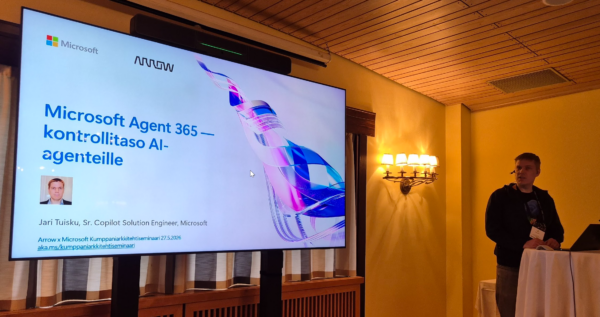
I attended Microsoft partner architect seminar in Hilton Kalastajatorppa. I had one session about developing Copilot Studio agents with Claude Code and then I participated other sessions. In the session led by Jari Tuisku (Microsoft), the focus was not on building agents—but on something equally important: how to observe, govern, and secure them at scale with Microsoft Agent 365.
This is where AI moves from experimentation to something organizations can actually manage.
The Core Idea: A Control Layer for Agents
The starting point is simple.
Organizations are already:
- Creating agents in Copilot Studio
- Using SaaS-based AI agents
- Running agents across endpoints and cloud environments
And the number is growing fast.
Agent 365 exists to answer one key question:
How do we manage all of this systematically?
It introduces a central control layer where agents are:
- Discovered
- Monitored
- Governed
- Secured
Without this, the risk is obvious: Agent sprawl becomes the new “Teams sprawl”.
Observe: Finally Seeing Your Agents
The first pillar is observability.
Agent 365 provides:
- A centralized registry of all agents
- Visibility regardless of where the agent was created
- Filtering and inspection capabilities
One particularly powerful capability is visualization:
- Agents can be mapped
- Relationships between agents can be seen
- Interactions become visible
This matters because:
You cannot govern what you cannot see.
Govern: Policies, Control, and Lifecycle
The second pillar is governance.
Agent 365 introduces:
- Policy templates to control agent behavior
- Grouping and classification mechanisms
- Controls for access and capabilities
This allows organizations to define:
- What agents are allowed to do
- What systems they can access
- How they are deployed and managed
Importantly, governance can be automated and standardized, rather than manual and reactive.
Secure: Extending Existing Security to Agents
The third pillar is security.
Instead of inventing something completely new, Microsoft extends existing security tools:
- Defender
- Entra
- Purview
Agents are treated similarly to users:
- They have identities
- They have permissions
- They can be monitored for threats
This is a crucial shift:
Agents are no longer “scripts” or “bots”—they are digital identities inside your environment.
A Key Insight: It Builds on What You Already Have
One of the strongest messages from the session was how familiar this all is.
Agent 365 does not introduce an entirely new model.
Instead, it extends:
- Admin Center
- Identity management
- Security tooling
Which means:
If you understand M365 governance—you already understand most of Agent governance.
This lowers the barrier significantly for organizations starting this journey.
Beyond Governance: Building Real Digital Colleagues
Where things get really interesting is what you can build on top of Agent 365.
The session showcased an example: A “digital colleague” called an IT Wizard.
This agent:
- Has its own identity
- Can participate in Teams conversations
- Can access systems like ServiceNow
- Can analyze incidents and escalate issues
In practice, it:
- Observes user-reported issues
- Checks known data sources
- Suggests actions
- Escalates when needed
This is not just automation—it is:
An active participant in daily work.
Agents as Team Members
This leads to a fundamental shift.
Agents are evolving into:
- Participants in conversations
- Owners of tasks
- Operators in processes
With:
- Their own identity
- Their own access rights
- Their own responsibilities
And this creates a new reality:
Agents are no longer tools—they are part of the team structure.
The Emerging Challenge: Scale and Visibility
One of the most practical observations from the session:
Organizations often don’t even know how many agents they already have.
And that number is only increasing.
This creates real challenges:
- Lack of visibility
- Uncontrolled access
- Rising costs
- Security risks
Which is why Agent 365 is not a “nice to have”—it becomes essential.
Final Thoughts
Microsoft Agent 365 represents a critical missing piece in the AI landscape.
Not because it enables agents—but because it makes them manageable.
It bridges the gap between:
- Innovation → Control
- Experimentation → Production
- Individual agents → Governed ecosystems
And perhaps most importantly:
It enables organizations to scale AI safely, before the chaos starts.
For architects and partners, the implication is clear:
- Building agents is only half the story
- Managing them is where long-term value is created