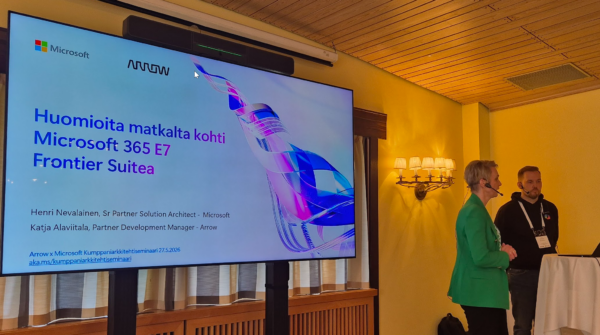

I attended Microsoft partner architect seminar in Hilton Kalastajatorppa. I had one session about developing Copilot Studio agents with Claude Code and then I participated other sessions. First session for me was about E7 by Katja Alaviitala, Partner Development Manager, Arrow and Henri Nevalainen, Senior Partner Solution Architect, Microsoft.
The introduction of the Microsoft 365 E7 Frontier Suite is not just about adding new features. It reflects a broader transformation toward agent-driven organizations, where AI is not only assisting users but actively performing work on their behalf.
According to insights shared during the session, organizations are rapidly adopting AI agents:
- A growing majority are already using or experimenting with them
- A significant proportion plan to integrate agents into core business processes within the next few years
This signals a clear shift: AI is no longer an experimental layer—it is becoming part of the operational backbone.
From Copilot to Colleague
One of the most important changes highlighted was the evolution of Copilot itself.
Initially introduced as an assistant, Copilot is now evolving into something more powerful:
- It does not just suggest actions—it executes them
- It supports iterative work, editing and improving content directly
- It enables multi-step task execution across applications
For example, with new capabilities, users can:
- Generate documents, presentations, and reports in a single workflow
- Ask Copilot to update or refine content instead of manually editing it
- Delegate complex tasks that span data sources and systems
This transformation fundamentally changes user productivity. Work is no longer about “doing tasks faster”—it’s about offloading tasks entirely.
The Rise of AI Agents in Everyday Work
A central theme of the session was the explosion of AI agents inside organizations.
What makes this shift significant is not just scale—but how agents are used:
1. Personal Productivity
Most organizations today are here:
- Agents assist with emails, meetings, and daily tasks
- Humans remain fully in control
2. Process Augmentation
Next stage:
- Agents become “digital colleagues”
- Tasks within processes are delegated to AI
3. Autonomous Processes
The future state:
- Entire workflows are handled by agents
- Humans focus on oversight, design, and optimization
Importantly, organizations can be in different stages simultaneously across departments—creating a strong opportunity for partners to guide the journey strategically.
Governance, Security, and Control: The Hidden Challenge
With scale comes responsibility.
As Henri Nevalainen emphasized, deploying AI agents introduces similar challenges to onboarding human employees:
- Identity management
- Access control
- Monitoring and compliance
- Risk mitigation
This is where the E7 Frontier Suite becomes critical. It brings together:
- Advanced security and compliance capabilities (from E5 and beyond)
- Identity and Zero Trust principles via Entra
- Copilot and AI capabilities
- Agent lifecycle management (via Agent 365)
The key takeaway:
The real challenge is not can agents do the work, but how to enable them safely and at scale.
What’s Changing Right Now in Microsoft 365
Beyond the strategic direction, the session also covered practical updates partners should be aware of:
Pricing and Licensing Changes
- Several enterprise and business plans are seeing price increases
- Timing matters—licensing decisions today can delay cost impacts
Copilot Expansion
- Copilot capabilities are expanding across core applications
- Even without full licenses, lightweight interactions (e.g., document-based chat) are becoming more available
Teams Evolution
- New capabilities like Town Hall events replace legacy live events
- Improved scalability and built-in streaming optimizations
- Enhanced collaboration scenarios with embedded AI agents
Device Management and Security Enhancements
- Expanded Intune capabilities integrated into higher-tier plans
- More granular control aligned with Zero Trust principles
- Security Copilot bringing AI into security operations
The Partner Opportunity: From Selling Licenses to Enabling Transformation
Perhaps the most important message for partners was implicit but powerful:
This is not just a licensing evolution—it’s a business opportunity.
Partners are uniquely positioned to:
- Help customers identify where agents deliver the most value
- Design governance and security models for AI adoption
- Build and orchestrate multi-agent solutions
- Avoid the “Teams chaos” scenario—this time with agents
As highlighted in the session, organizations are already starting to deploy hundreds of agents internally. Without proper structure, this can quickly become unmanageable.
Final Thoughts
The journey toward Microsoft 365 E7 Frontier Suite represents a shift from:
- Tools → Platforms
- Assistance → Execution
- Users → Hybrid human-agent workforces
For partners, the question is no longer whether this change will happen—but how quickly you are ready to lead it.
The organizations that succeed will not simply adopt AI—they will operationalize it securely, strategically, and at scale.