
AI agents often stay at the edges—chatbots, assistants, or isolated use cases.
But the real value starts when agents are embedded inside core business processes.
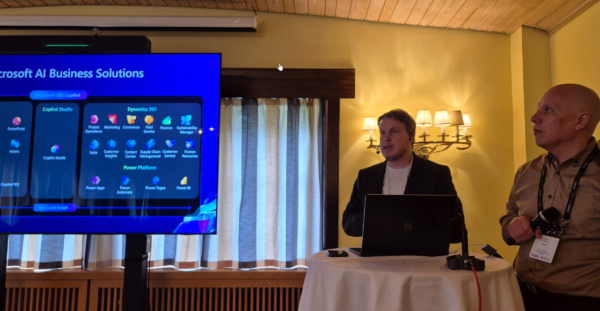
I attended Microsoft partner architect seminar in Hilton Kalastajatorppa. I had one session about developing Copilot Studio agents with Claude Code and then I participated other sessions. In the session “Agent Stories Part 3: Using Agents in Business Processes (Dynamics MCP)”, Erno Soinila and Jani Sahlman explored exactly this:
how agents can connect systems, support process execution, and bring automation directly into Dynamics 365 Finance & Operations scenarios.
From Assistants to Process Participants
A key shift highlighted in the session:
Agents are no longer just interfaces—they are becoming part of the process itself.
Instead of:
- Users asking questions
- Agents returning answers
We move toward:
- Agents triggering actions
- Agents interacting with systems
- Agents supporting or executing process steps
This represents a clear evolution:
From chat → to process orchestration.
MCP: Opening Systems for Agents
At the center of this shift is MCP (Model Context Protocol).
MCP enables agents to:
- Connect to business systems (like ERP and Dynamics)
- Access data and operations
- Execute actions through controlled interfaces
In practice, this means:
- Dynamics APIs and services become accessible to AI
- Business logic can be exposed securely
- Agents can move beyond read-only interactions
Dynamics as a Connected Process Layer
The session showed how Dynamics 365 Finance & Operations fits into this architecture.
Agents can:
- Read financial and operational data
- Trigger transactions
- Support decision-making
Examples include:
- Financial queries and reporting
- Order handling and validation
- Process support across procurement and accounting
The important part:
Dynamics is no longer just a system users work in—it becomes a system agents work with.
Balancing Speed vs Accuracy
One practical challenge highlighted was performance.
When agents call systems directly via MCP:
- Data is accurate and real-time
- But response times can be slower
To solve this, a hybrid pattern is used:
- Frequently used data is replicated (e.g., to AI Search)
- Agents query replicated data for speed
- Critical updates still go through MCP for accuracy
This introduces a trade-off:
Freshness vs speed—and solutions must balance both.
Architecture Pattern in Practice
The typical architecture looked like this:
- User interface (often Teams or Copilot)
- Copilot Studio as orchestration layer
- MCP connectors for system access
- Data replication for performance (e.g., AI Search, Fabric)
This layered approach allows:
- Fast user interactions
- Reliable system-level operations
- Flexibility to extend across multiple systems
Combining Low-Code and Pro-Code
A strong theme continued from earlier sessions:
Real solutions combine:
- Low-code tools (Copilot Studio, Power Platform)
- Pro-code layers (Agent Framework, Python, APIs)
For example:
- Complex workflows can be implemented in code
- Exposed as agents to Copilot Studio
- Used seamlessly by business users
This creates a powerful pattern:
Developers build the complexity → business users consume it through agents.
Multi-Agent and Workflow Flexibility
The session also showed how agent solutions can evolve:
- Simple pipelines → AI-enhanced processes
- Autonomous agents → limited scope ownership
- Multi-agent architectures → complex orchestration
However, an important point:
Not every process needs a complex multi-agent system.
Many valuable solutions remain:
- Simple
- Focused
- Integrated into existing workflows
Cost and Efficiency Considerations
A practical (and often overlooked) topic was cost.
Two optimizations discussed:
- Reducing token usage with structured “skills”
- Minimizing unnecessary system calls
These become critical when:
- Scaling to large volumes
- Running frequent automated processes
This highlights a key operational reality:
AI architecture is not just about functionality—it’s also about efficiency.
A Key Insight: Don’t Wait for Perfect Solutions
One subtle but important takeaway:
The ecosystem is still evolving rapidly.
- MCP capabilities are expanding
- New integrations appear frequently
- Best practices are still forming
Which means:
Waiting for a “perfect architecture” will only slow you down.
Instead:
- Start building
- Learn from real use cases
- Iterate continuously
Final Thoughts
Agent Stories Part 3 shows what happens when AI moves deeper into operations.
The shift is clear:
- From assistants → to process participants
- From isolated tools → to connected ecosystems
- From experiments → to production workflows
And the key enabler:
The ability to connect systems, data, and logic through MCP.
For organizations working with Dynamics:
- The opportunity is not just better interfaces
- It’s rethinking how processes are executed
Because ultimately:
The real value of agents is not in answering questions—but in helping the business actually run.