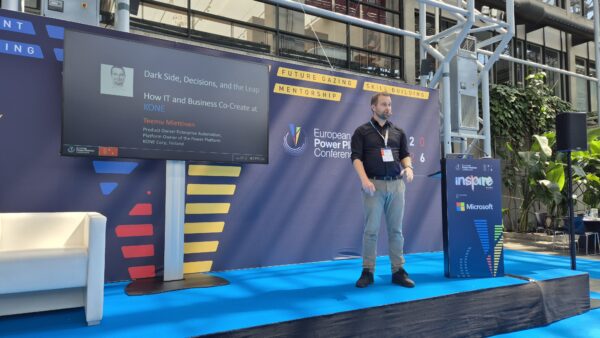
European Power Platform Conference, Copenhagen | June 30, 2026 | Inspire Stage | Level 100 — Business Decision Maker
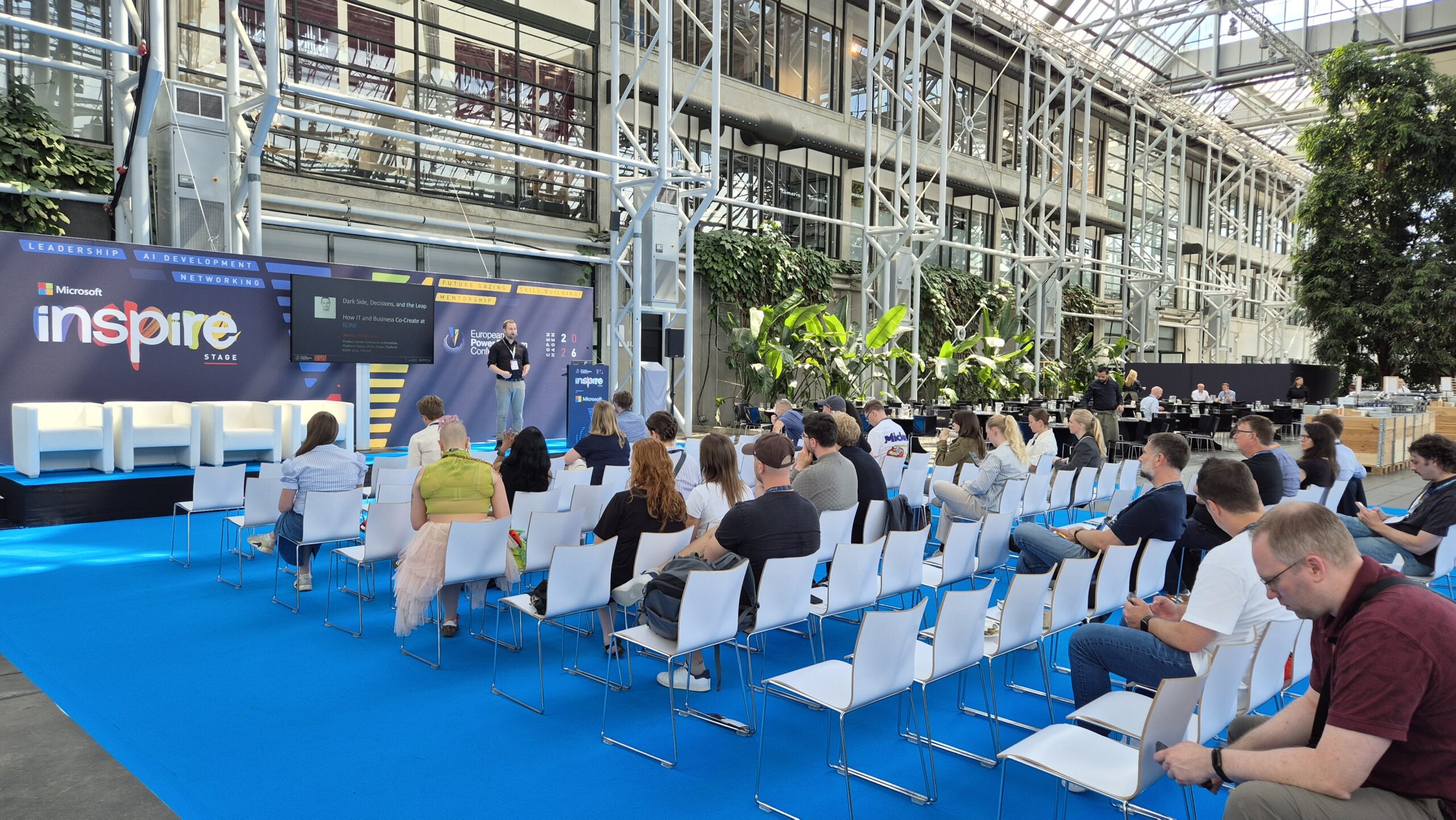
When a company operates elevators and escalators in over 60 countries and has grown through decades of global acquisitions, the IT landscape inevitably becomes a patchwork of disconnected systems and legacy platforms. At EPPC26, Teemu Miettinen, Product Owner for Enterprise Automation at KONE Corporation, walked through how the company turned that complexity into an opportunity — and what the Power Platform journey actually looks like at enterprise scale.
The Starting Point: Heterogeneous IT and a Dual Mandate
KONE’s challenge was familiar to many large enterprises: a highly heterogeneous IT stack accumulated through acquisitions, with limited visibility into what local business units were building and running. With a new acquisition on the horizon — one expected to double the workforce and add yet another IT stack — the pressure to establish governance was real and urgent.
The answer was a dual strategy:
– Citizen development — empower business users to solve local problems quickly
– Professional development — build enterprise-grade, business-critical solutions through a central IT team
Power Platform was chosen because it supports both tracks simultaneously: low-code/no-code for speed, and full lifecycle management and Azure integration for complex, scalable solutions.
Three-Tier Development Model
One of the clearest frameworks from the session was KONE’s three-tier model for development ownership:
| Tier | Owner | Scope | Governance |
|---|---|---|---|
| Citizen | Individual makers | Personal productivity, local problems | Low — standard E5 connectors, non-managed environments |
| Business (Advanced Citizen) | Business units | Significant apps using premium capabilities | Medium — managed environments, compliance gates, data owner approvals |
| Enterprise | Central IT team | Business-critical solutions, 3,000+ user apps | High — full lifecycle, Azure integration, IT-owned production |
Teemu was candid about the challenge: the middle tier is the hardest to govern. Advanced citizen developers want to build real things with real data — including SAP integrations — but without the discipline that IT-grade systems require. Getting this tier right is where most governance investment has gone.
Power Up 360: The Intake and Visibility Platform
To replace a chaotic mix of emails, ad-hoc meetings, and informal requests, KONE built Power Up 360 — a centralized intake and visibility platform that acts as the front door for all Power Platform work.
Key capabilities:
– Application catalog — every production app must be documented with business justification and estimated savings before it can be published
– License and access automation — integrates with enterprise access management to handle provisioning compliantly, eliminating ServiceNow ticket overload
– Bi-weekly review — a structured process for prioritizing and routing incoming requests
The catalog is especially important: by requiring documentation before production access, KONE forces makers to articulate business value — which in turn makes that value visible to leadership.
Compliance by Design: Maker and Admin Certificates
Governance without enforcement is just documentation. KONE built compliance directly into the access flow:
- Maker certificate — every maker must pass a compliance test before gaining access to federated environments. The test covers policies such as “consult the SAP team before building SAP-related automations.” Non-compliant users are blocked and reminded automatically.
- Admin certificate — regional admins complete a formal certification as part of change management, formalizing their responsibilities in the federated model.
This approach shifts governance from a gatekeeping exercise to an onboarding one — with access as the incentive.
AI Ops at Scale: The Orion Bot
With over 6,000 AI agents running in Copilot and Copilot Studio across the organization, manual oversight is impossible. KONE built Orion — an AI-powered operations system for their RPA and automation estate.
Orion provides:
– Bot health monitoring and issue detection
– An AI assistant that searches Jira and internal documentation for known solutions
– Log access that allows junior team members to troubleshoot without senior intervention
The result: the team scales RPA operations without scaling headcount. This is “AI Ops” in practice — using agents to manage agents.
The Numbers
- ~5,000 active makers across the organization
- 6,000+ AI agents in production (Copilot and Copilot Studio)
- ~110 business-critical applications managed by the central IT team
- Sufficient licensing to avoid architectural compromises — a deliberate investment decision
The licensing point is worth noting: Teemu emphasized that trying to design around license limitations leads to technical debt. KONE chose to invest in the right licensing upfront and design solutions correctly from the start.
What’s Next
KONE’s roadmap reflects the maturity of their platform journey:
- GitHub for version control and pipelines — replacing current pipelines to enable coordinated deployments across Power Platform and Azure, and using GitHub Copilot for automated quality assurance
- Agent 365 for AI governance — runtime monitoring of AI agents before citizen developers get access to Copilot Studio authoring
- Foundry IQ integration — creating reusable “data products” that encapsulate SAP, SharePoint, and other data sources with vector indexing, giving citizen developers AI-ready, standardized data interfaces
- Copilot Studio for advanced citizens — unlocking agent-building for business users once security guardrails are in place
Key Takeaway
KONE’s story is a masterclass in enterprise-scale Power Platform governance — not as a bureaucratic constraint, but as the infrastructure that makes scale possible. The central insight: governance must be designed into the access flow, not bolted on afterward. When compliance is the path to getting things built, adoption and governance move together instead of against each other.
For organizations navigating the same tension between citizen enablement and enterprise control, KONE’s federated model, tiered development approach, and Power Up 360 platform offer a practical blueprint.
Session TI03: “Dark Side, Decisions, and the Leap – How IT and Business Co‑Create at KONE” — EPPC26 Inspire Stage, Copenhagen, June 30, 2026
Speaker: Teemu Miettinen, KONE Corporation