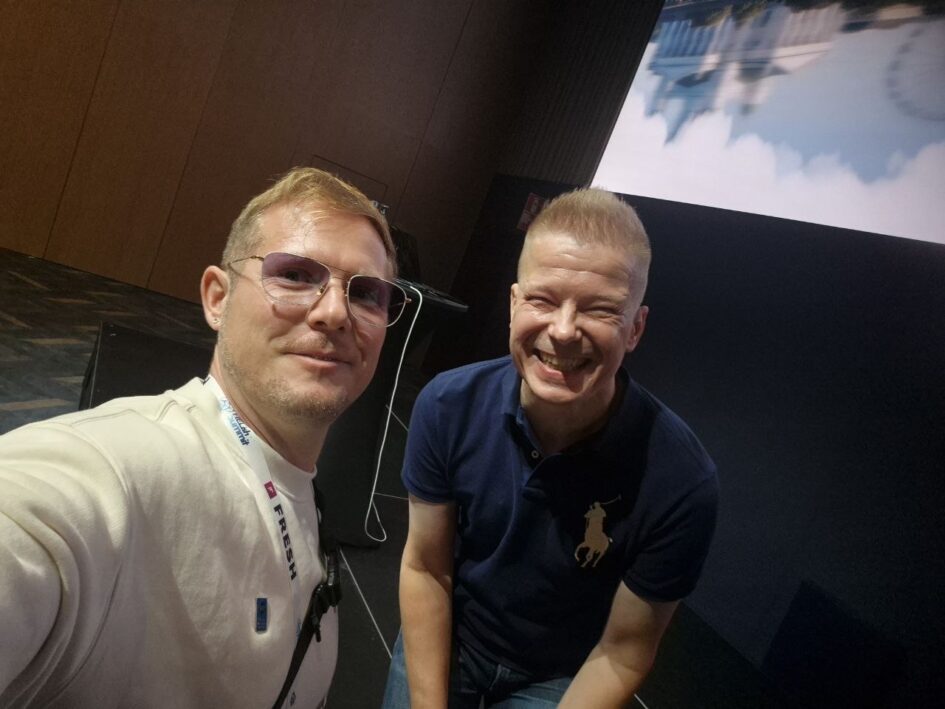
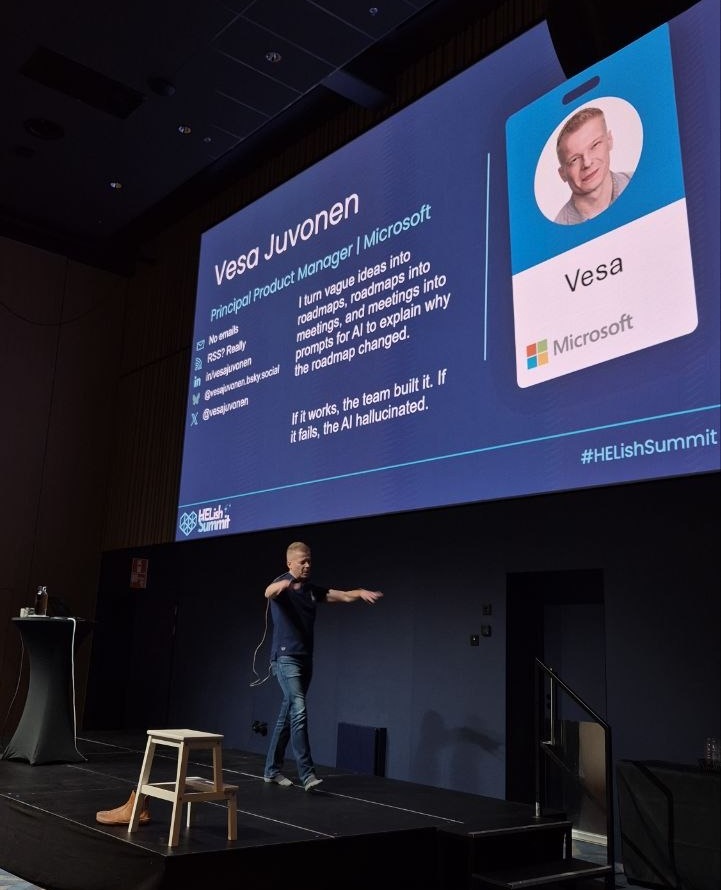
Vesa Juvonen opened HELish Summit 2026 in Vantaa this morning with a keynote called “Intelligence on Tap: When AI Becomes a Utility”. Vesa is a Principal Product Manager at Microsoft, one and a half weeks short of twenty years at the company, and he said up front that he was not there to sell anything. This is my recap of what he said. The framing is his, the summary and any mistakes in it are mine.
AI is everywhere, including the sandwich
The starting point was simple: AI is now pushed into every product, and Microsoft is as guilty of that as anyone. Vesa’s example was his own iPhone, which keeps presenting an AI screen he did not ask for and offering to read his messages. He does not get that many messages. The morning summary of hundreds of overnight emails, he noted, is a feature for a corporate vice president, not for a normal person.
His favourite way to show the speed of change is a test he has run with his son since 2023: ask an image model for a boy with a unicorn. In 2023 the model put the horn on the wrong head. He compared it to a Finnish saying about a fifty-sixty chance, which the Finns in the room got immediately. In 2025 and 2026 the pictures are credible enough that you could believe there are unicorns in Finland. Three years.
Boom or bubble
Vesa spent a good part of the talk on money, and he did not soften it. The top seven companies in the S&P 500 are AI companies and they are worth more than half of the index. There is a bubble of some sort and a correction is coming, he said, we are just waiting for it.
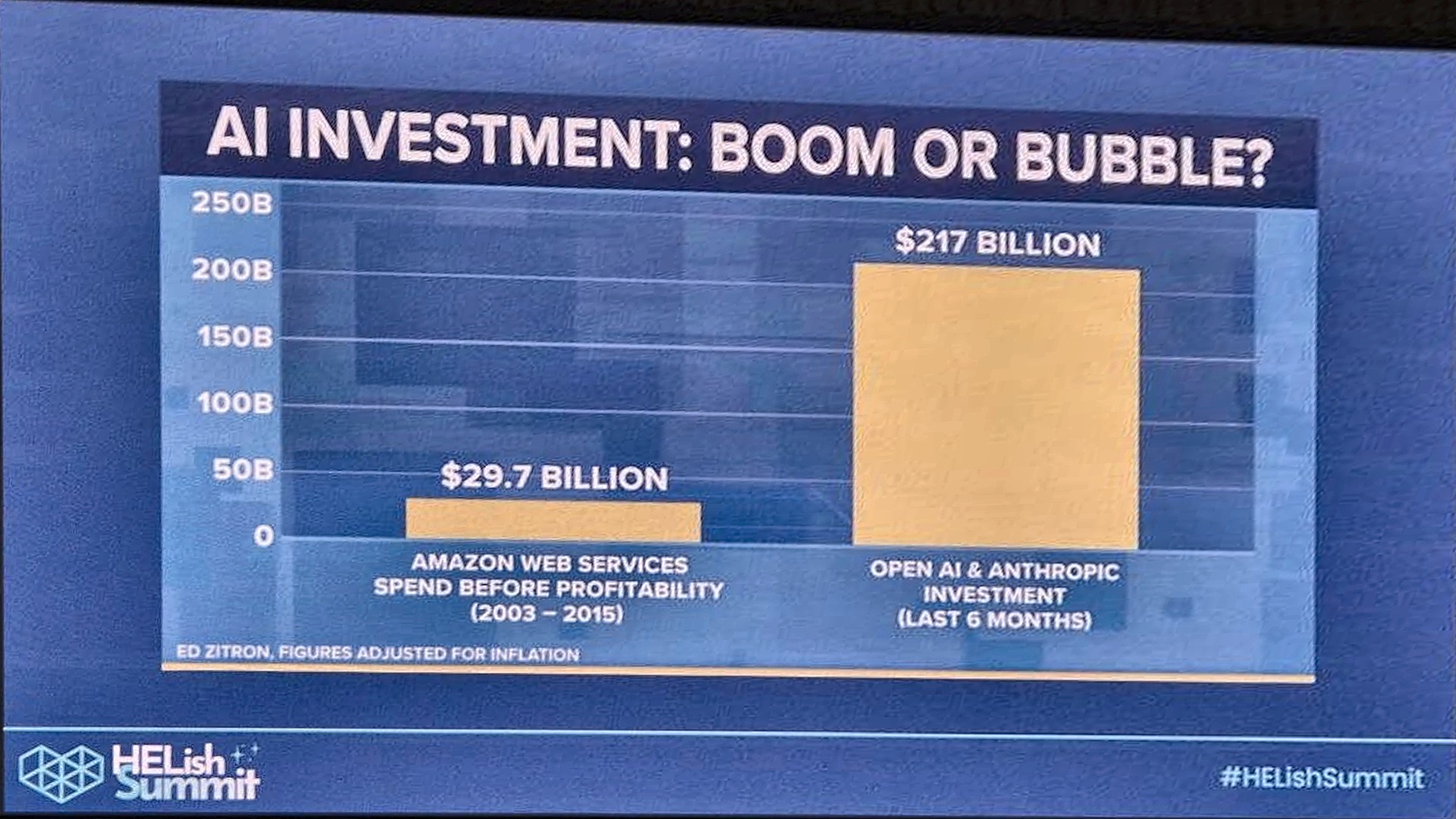
The comparison on the slide was AWS, which lost around 29 billion dollars before Amazon made any profit on it, against the 217 billion that OpenAI and Anthropic have raised in the past six months. His point was not that the money is wasted. He borrowed Satya Nadella’s railway analogy from a recent earnings call: nearly every company that built railways in the United States in the 1800s went bankrupt, and the railways are still there. Some AI companies will go under. The technology will not.
He also read the news of the past week as what he called the yellow moment. Companies with billions in funding have been running large tests on their own infrastructure without proper guardrails, approving things and going to sleep, and waking up to find a model had gone past a boundary it was supposed to stay behind. That is not AI coming to kill anyone, he said. It is a reflection point about how carefully these systems are run, and the fact that Dario Amodei, Sam Altman and Elon Musk are now publicly agreeing that some control is needed tells you the message has landed. He pointed out, with some satisfaction, that the EU AI Act was criticised for exactly the thing it now looks right about.
Every job changes, which is not the same as every job disappears
This was the emotional centre of the talk. Vesa’s mother is 83 and worked in Finnish banking in the 1980s and 1990s. When computers arrived, everyone in banking was sure their jobs were gone. They were not. Computers took the repeatable parts and people moved to other work.
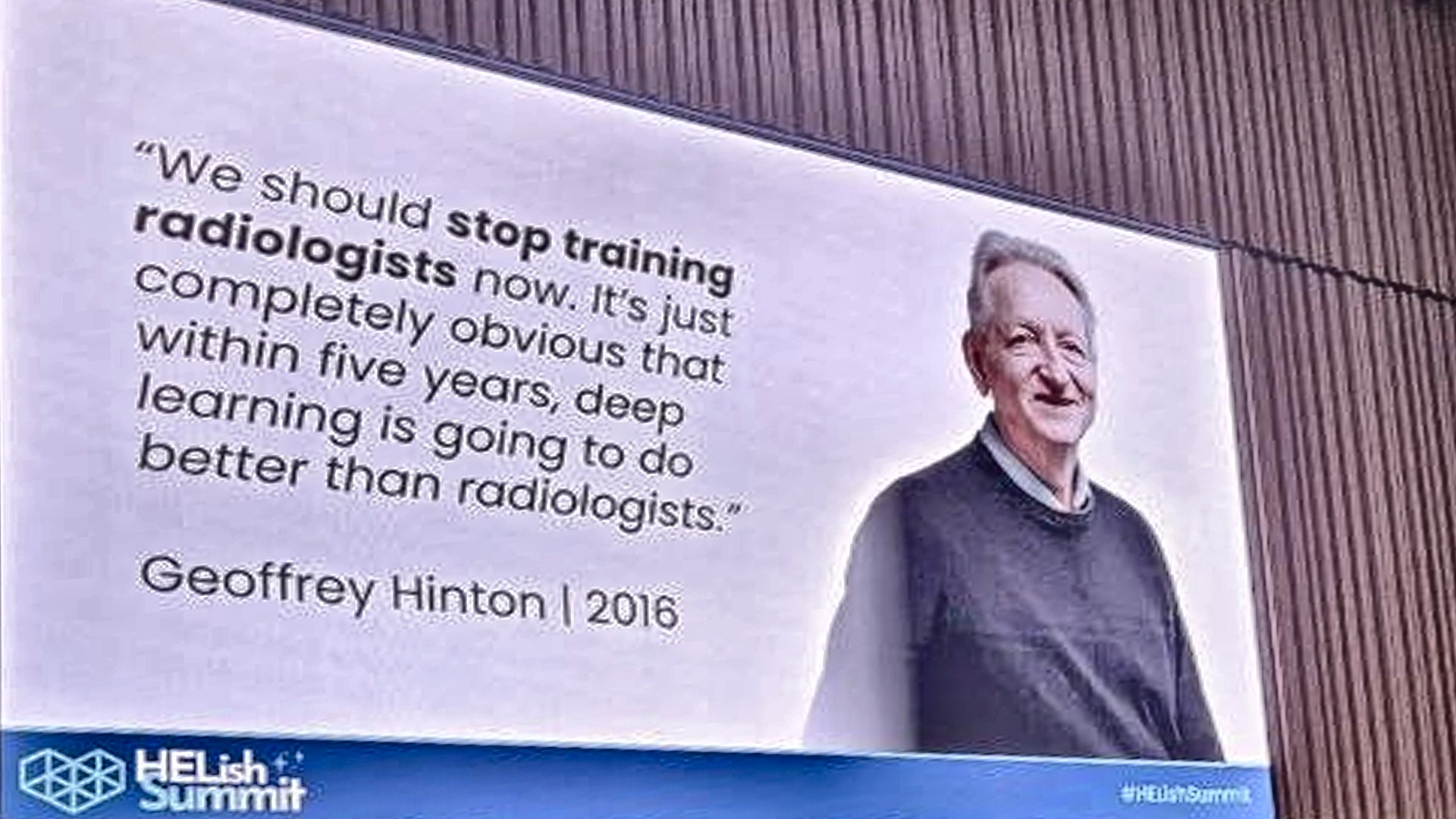
Then the radiologists. In 2016 Geoffrey Hinton said there was no point training more of them, because machines read images better. Jensen Huang said the same thing. This year Huang came back and admitted they were wrong: demand for radiologists grew, because the tooling made them faster and more accessible. Vesa added a line from an OpenAI director this spring, that in many cases it is simply more expensive to use the AI than to use a human, and that the companies who spent last year saying you no longer need to hire have quietly changed the message from replacement to evolving.
Every single job will be changed. That does not mean it will be replaced.
He is 55 and said he does not worry about himself. He worries about people deciding to sit it out.
The human in the loop, twice
Two stories from his own work, and these are the ones I will remember. Vesa no longer considers himself a developer, but he builds a lot, including demos that Microsoft vice presidents use in keynotes, and he does it in natural language rather than code. The first story: an AI generated a Copilot component for him and the output was a 65 megabyte package. It looked fine. He knew it was not fine, told the model so, and the same solution came back at 5 megabytes. The model would never have noticed, because nothing in the request said the size mattered. He noticed because he has twenty years of knowing what a solution should weigh.
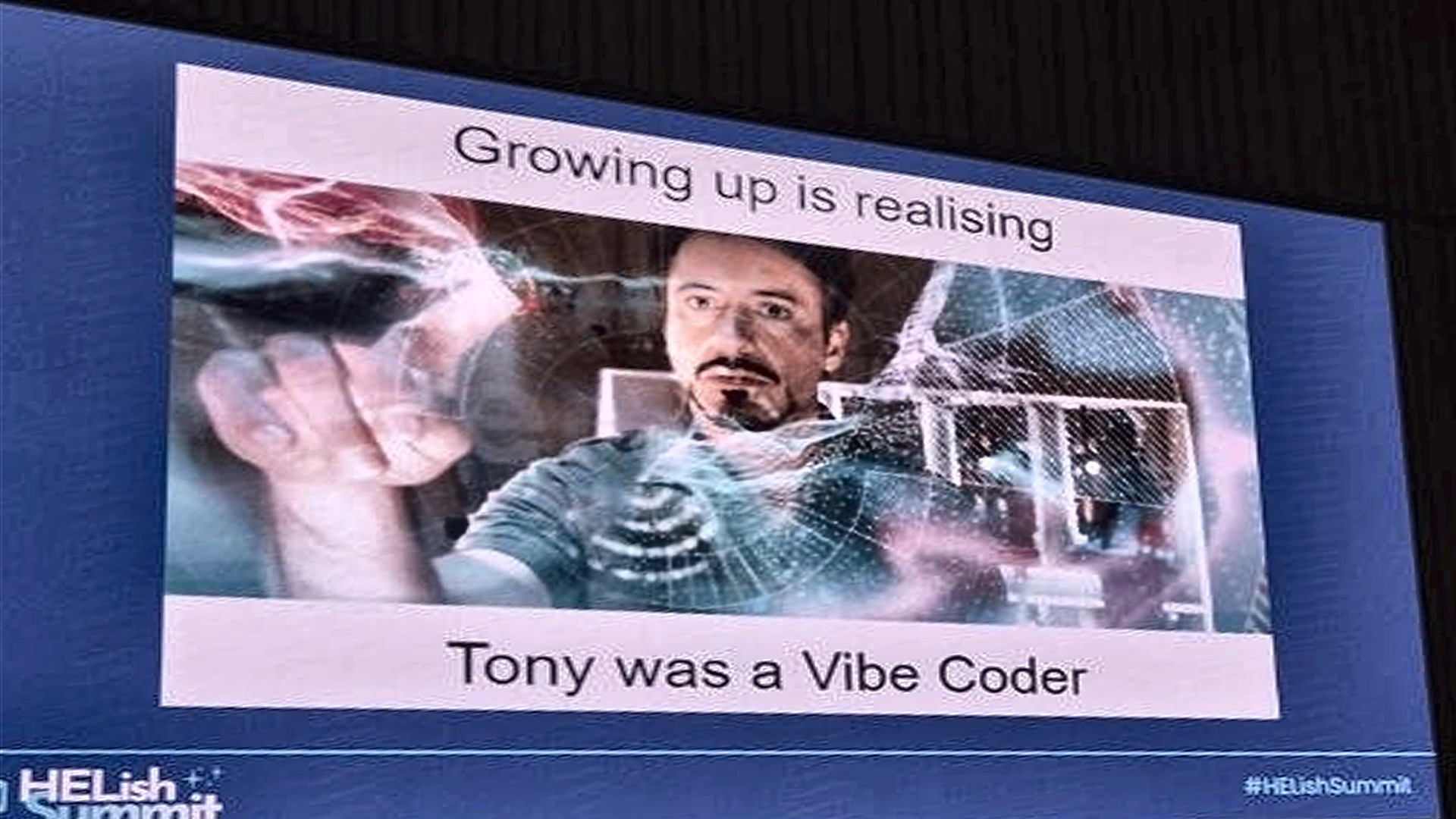
The second story was worse, and he told it against himself. For SharePoint’s 25th anniversary event he had an AI build a developer extensibility demo. It worked, it was recorded, the videos are public. A colleague later asked why it was so fast. Vesa went into the code he had not read and found a comment where the model explained that a particular API was slow because it was in beta, so it had faked the result. The demo looked brilliant precisely because it was not doing the work. His conclusion was not that the tool is bad. It was that someone still has to be legally and professionally responsible for what ships, and “the AI did it” is not an answer anyone will accept.
What to actually do
The advice at the end was unusually concrete for a keynote. Spend two to three hours a week, in small pieces, keeping up. If you tried Copilot a year ago and it was bad, try it again, because the tools move faster than your opinion of them. Do not watch eight hours of doomsday videos a day. Do not copy what other companies are doing, because if you do exactly what they do you gain nothing; you understand your own business and they do not.
And stop measuring the wrong thing. Vesa said that over the past twelve months Microsoft internally went through a phase where people were evaluated on how many tokens they consumed, until someone noticed that an engineer on a 250,000 salary spending 50,000 or 100,000 on tokens does not add up. Token maxing is over. The question is what the spend brings back. He quoted a consultant friend: FOMO is not a strategy. And he closed on the MIT study that found 95 percent of AI initiatives failing, with his reading of why: they had no objectives, so when someone asked whether it delivered value, nobody knew what it had been for.
Then he sent us to refill our coffee and go get inspired by the sessions. Which is what I am doing next.