HELish Summit 2026 closed at 16.50 in Runway 2 with Jouni Heikniemi, CEO of Zure, and “The cardinal sins and deep roots of AI”. He opened with a confession: he used to be an IT and AI consultant, a year ago he drew a tidy slide of how AI adoption progresses, then quit, spent six months at home, and came back to run a 100-person consulting company. The talk was what he learned in between. This is my recap of a recording that runs about 28 minutes; the argument and the numbers are his, the compression is mine.
A year of news, a slide that did not change
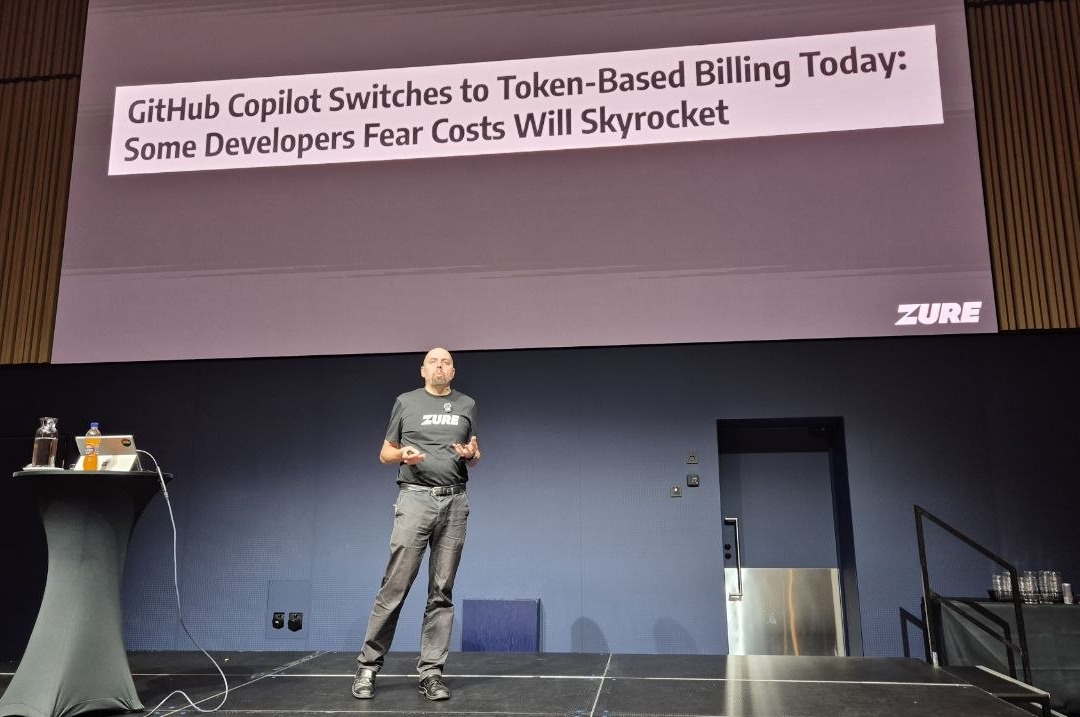
He walked through the waves of the past year: personal agents on clusters of Mac minis and an agent social network, forgotten in two weeks; the METR time-horizon benchmark promising agents that finish days of human work, with the small print that the 50 percent success rate means failing half the time; a video model that changed everyone’s idea of generated content; an acquisition announced and cancelled; agent governance products that three people in the room said they use; politics; pay-as-you-go pricing for Copilot; and 142 models released this year up to the evening before, 79 of them flagship.
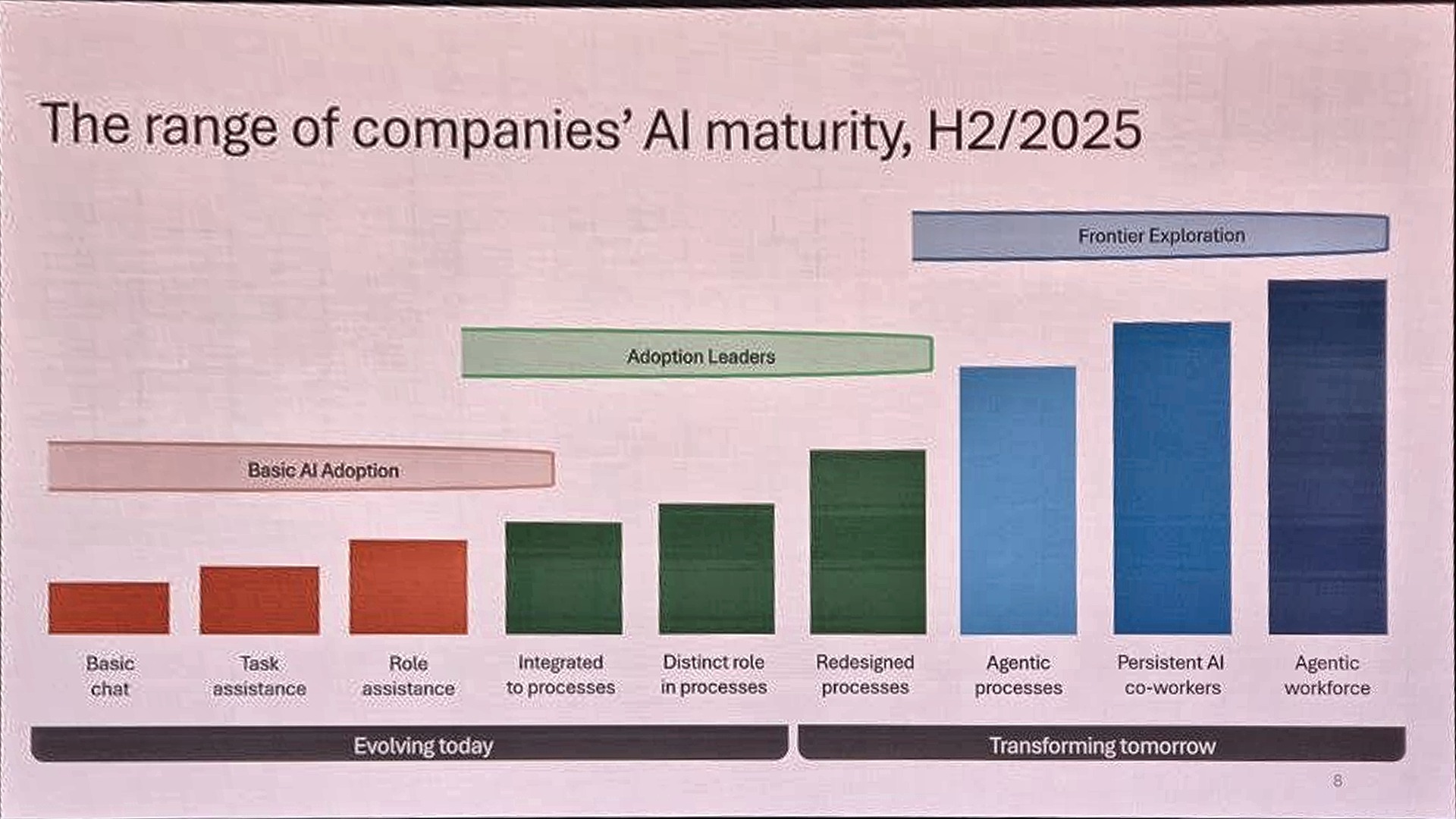
Then he put his year-old maturity slide back up. How much had changed? “Absolutely nothing.” He sees agents deployed in organisations; he does not see processes fundamentally altered by them. He asked the room, which he called the best Finland has to offer in this field, whether their organisations are driven by agentic processes. Zero hands.
What enterprise AI means, and the fifth element
His test for whether AI has touched an enterprise is simple: the onboarding process changes. If explaining how this company works includes “we do this thing with AI”, enterprise AI has arrived. Everything else is assistance. The often-quoted MIT figure that 95 percent of AI projects fail he dismissed as bad methodology, but he kept the shape of it: 95 percent of projects are misguided in the sense that they never had a chance to change the enterprise broadly.
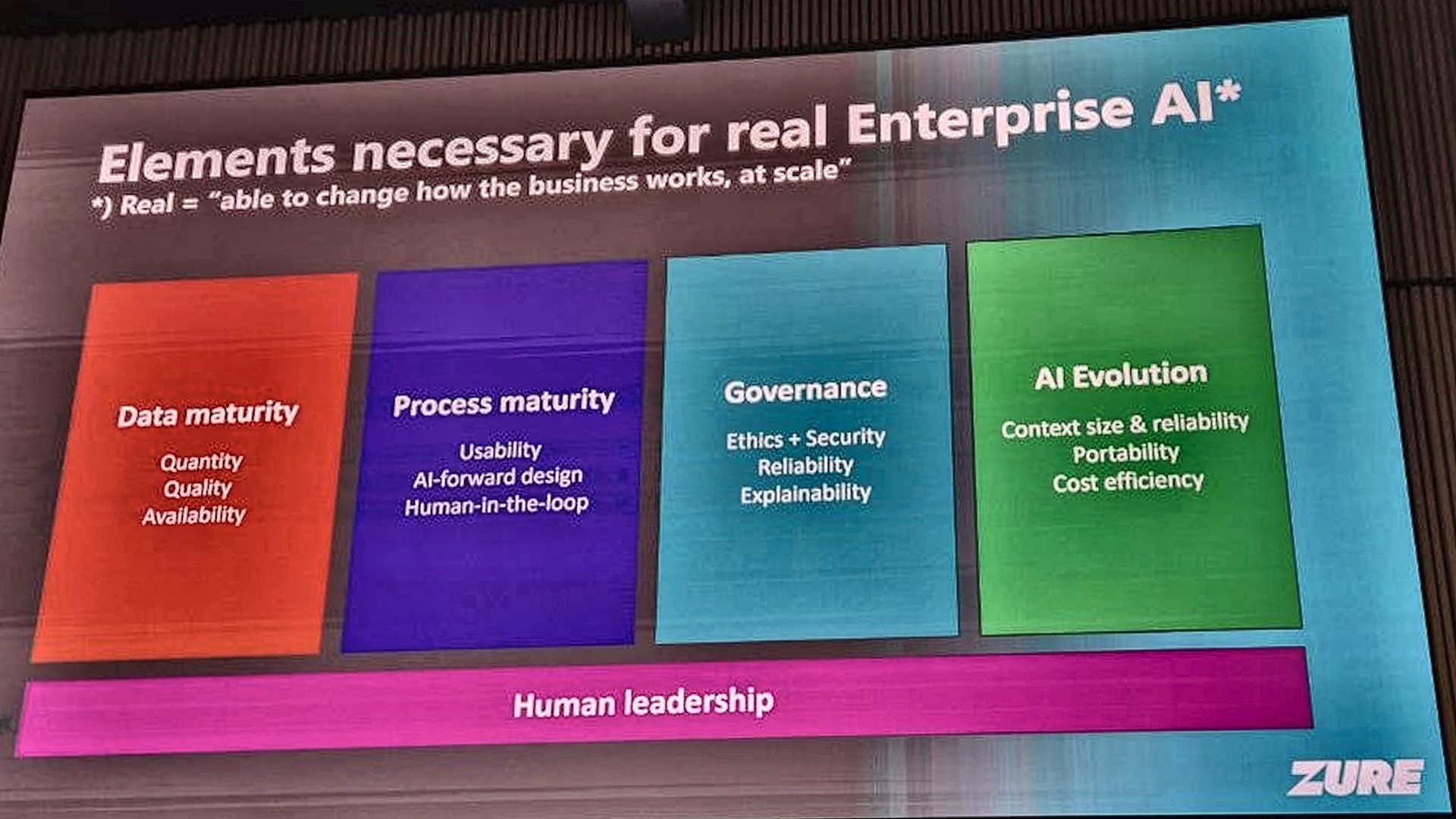
Four pillars: data maturity (quantity, quality, availability, all classic IT and none trivial), process maturity (usable applications, AI-forward design, humans in the loop), governance, and the evolution of AI itself, which he said is the one pillar we are not missing. Underneath, added later, human leadership.
Why each pillar is hard
Data is hard because enterprises store the “what” (customers, invoices, orders) but process agents also need the “why” (guidelines, policies), which lives on a SharePoint site next to seven old versions. The industry has revived the word ontology, but saying it does not organise anything; what it really means is making master data work, the expensive project IT tried to bury twenty years ago. Quality takes years. If you started adoption a year ago, your data is probably not right, and it will take two more years before you can even have a good try.
Process maturity is rare because AI is preceded by digitisation. A step that lives on a sticky note, or in a phone call to a colleague, is invisible to AI. You need digital flexibility to put AI exactly where you want it, observability because nobody changes a process without watching it, and what he called malleable human behaviour: someone whose job was doing the work may not want a job that is monitoring an AI doing it. That makes change leadership mandatory for everyone, because no leadership can see everything that happens in an organisation.
Governance is boring and hard. Access control is hard for humans and doubly so for agents they create. Knowing which decisions were made with what data needs logging most organisations do not have and could not query if they did. Quality assurance was hard for software; it is doubly hard for AI, which behaves differently every run, and a system of dozens of agents can produce conditions nobody predicted. And politics: AI cost has to become a business cost, not an IT cost. Whether it makes sense for accounting to burn a thousand euros of tokens a month is a question only the head of accounting can answer, and they are not used to budgeting tools monthly.
The usual answer is an AI champion network: the enthusiastic 5 percent, given 5 percent of their time. He said this is enough to support basic Copilot use and nothing more.
A help desk is not a change agent.
One in three business needs, by prompting
The real change coming, he argued, is pace. Organisations will clear their digital debt faster and faster, and vibe coding, which IT professionals currently sneer at for good quality reasons, will become safe for certain process problems once data and deployments are engineered for it. Then IT no longer controls process change; it controls the fundamentals that support it. His own prediction, explicitly not backed by any analyst: by 2030, one in three business process needs will be solvable by prompting, without deep technical skills. The consequence is a mass of small applications, and product and service ownership becoming a very intense role.
The craft agent: 220 pull requests a week
Then he showed what this looks like at Zure, a company founded by developers that builds almost all of its internal tools itself. On a page showing Copilot adoption metrics he wanted a filter by customer that did not exist. A small icon opens the craft agent: pick the element on the page, describe the feature request in two or three sentences, submit. In the background a GitHub Copilot SDK process reads the source code of the application, not its documentation, confirms its understanding, and in two or three minutes produces an implementation plan down to source-level changes and acceptance criteria. One click sends it to the Azure DevOps backlog. Their tooling team reviews what is ready to ship, hands it to an agent, and a pull request comes back for an engineer to review before it goes live.
The result: about 200 feature requests per week flowing through, 220 pull requests the previous week, without a single full-time person on tooling, and an automated weekly Teams summary that ran to eight pages. His request typically completes by the next morning. He was careful about the caveats: this only works if the data platform, integration and quality stack can keep up, and he is not always sure what they do is sustainable.
Humans are the blocker
The question that follows is whether 100 people, or 140 across the group, can absorb that much change every week. His honest answer: “we suck at it right now.” It works while the changes are small fundamentals; as they become real user scenarios, change management competence has to grow with the speed. Champions of AI, in his organisation and in yours, cannot stay champions of AI. They have to be champions of change, because the question is no longer how to use the tools but how to reinvent your work. Trust humans, he said, but make them better.
His closing: the four pillars are still his best understanding of what enterprise AI requires. Data, process maturity, governance and compliance, and AI evolution, which the world is taking care of for us. The part nobody else will do is leadership: make executives understand what is happening, and make sure everyone in the organisation can lead the transformation, because it is not going to be easy.