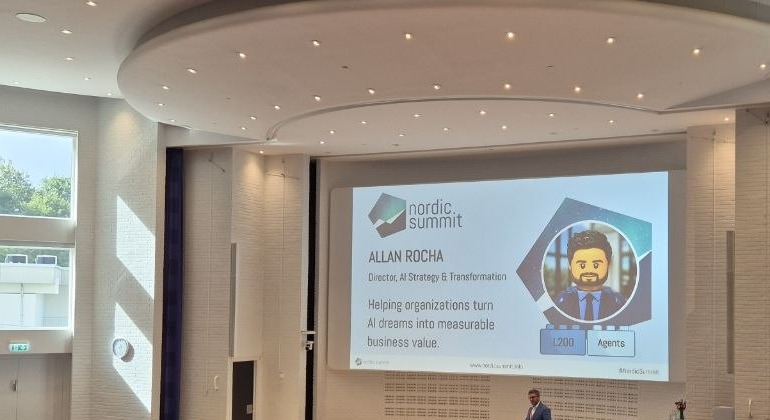
The sponsor slot after lunch at Nordic Summit 2026 went to Allan Rocha, Director of AI Strategy and Transformation at Fellowmind, with a session called “A Recipe for Not Succeeding with Agents”. He said up front that it was not a technical session and that it was mostly his own opinion from a year of field work with enterprise and public sector organisations, plus what he could gather from other research. Thirty minutes, no code, one product demo at the end. This is my recap. The recipes are his, the summary and any mistakes are mine.
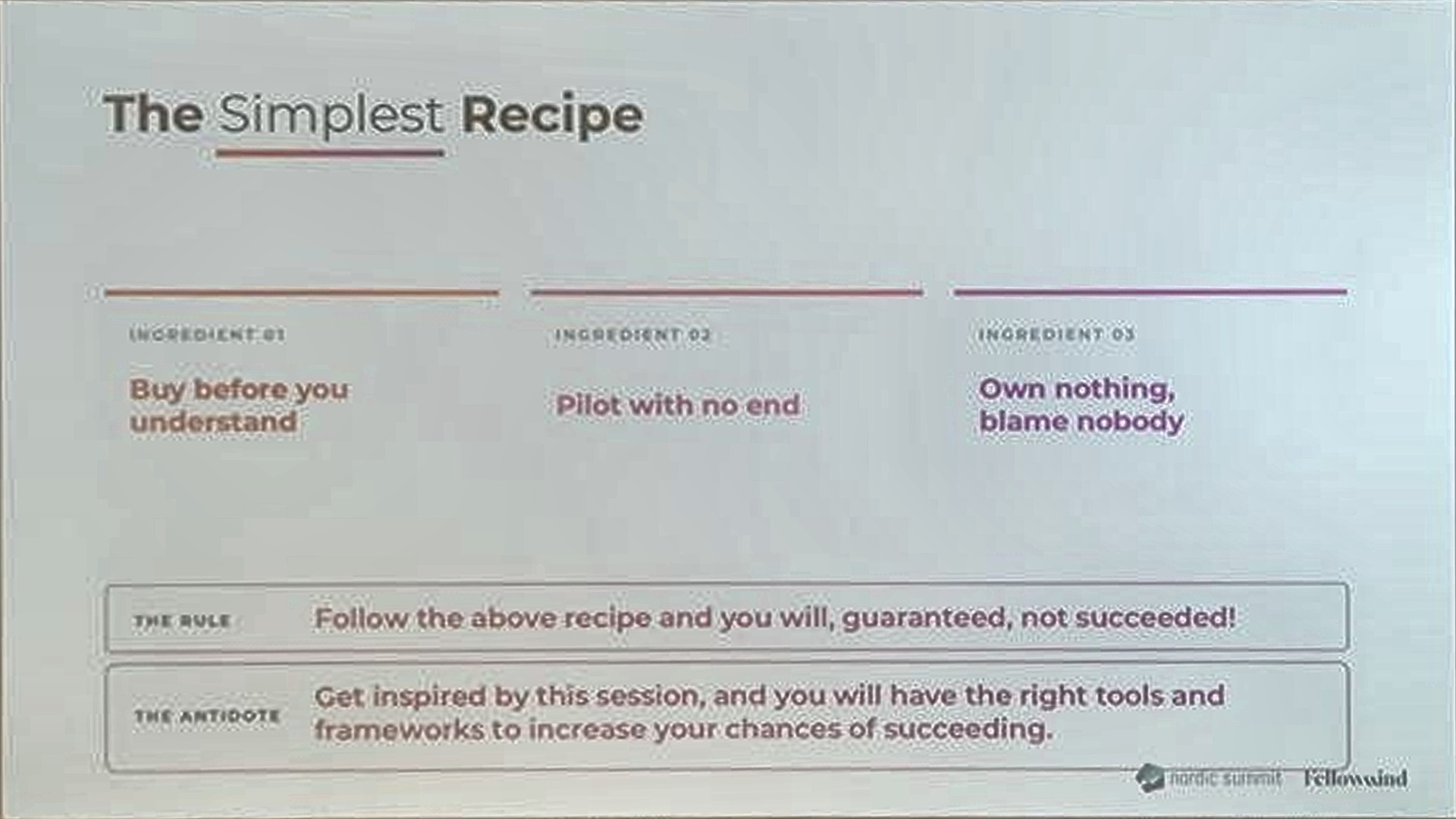
The simplest recipe
His starting point fits on one slide. Buy before you understand. Run a pilot with no end date. Own nothing, so there is nobody to blame. Follow those three and he guarantees the agent initiative will not succeed. Everything after that was one ingredient at a time, each with what he called an antidote: for a non-native speaker, the thing that kills the poison.
Let someone else define the problem
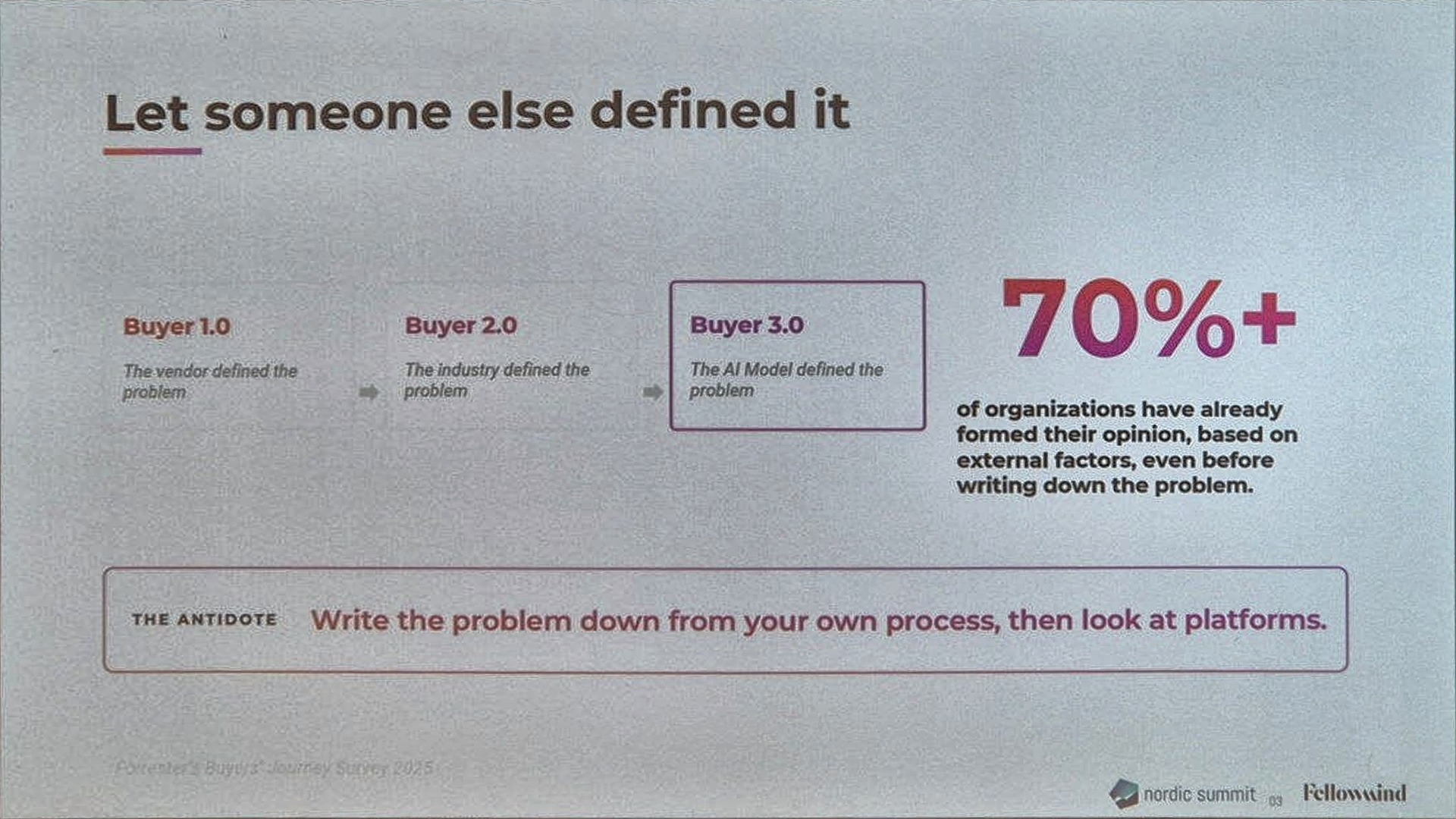
The first ingredient in detail was who frames the problem. Buyer 1.0 let the vendor define it. Buyer 2.0 let industry standards define it. Buyer 3.0, which he said everyone in the room has done, lets an AI model decide where and how the agent should be applied. Based on his own research and a Forrester survey cited on the slide, more than 70 percent of organisations have already formed their opinion from outside factors before writing their own problem down.
He came back to this at the end with a question to ask after any conversation with a partner: who framed the outcome? If the honest answer is “I follow what my vendor tells me”, you are buying, not deciding. The needs have to come from the organisation that knows what it is facing, even when an advisor facilitates the workshop.
Take no decision
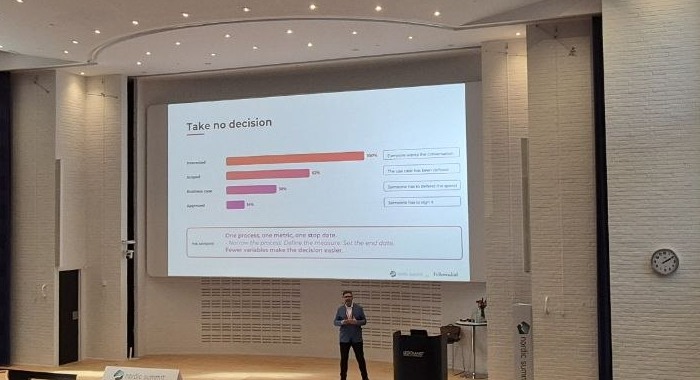
The second ingredient was decision-making itself. He borrowed a point from a course on how fear and risk shape decisions: if the budget is there but nobody understands who will own the thing or what it will change, deal with the real fear before taking the risk. Then the funnel. Everyone is interested, most initiatives get scoped, someone builds a business case, and only 14 percent get approved.
The related bad habits went by quickly. Let the tool frame the problem because you already know the tool. Treat a polished demo as evidence, because you can sell rocket science in a ten-minute demonstration. Treat go-live as the finish line, when the capabilities added afterwards are where the value is.
Four of the five phases get ghosted
This was the part with the most substance. He laid out five phases, decide, align, configure, adopt and optimise, and said that in most organisations four of them get no budget. The money goes to configuration: building the thing. Skipping the advisory phases at the start produces a chain of failures later, because you do not know what is coming; cutting continuation at the end means the agent is never improved. And after go-live there is a spike and then value goes down, unless somebody keeps optimising, which in a world with a new model every week is where the upside is.
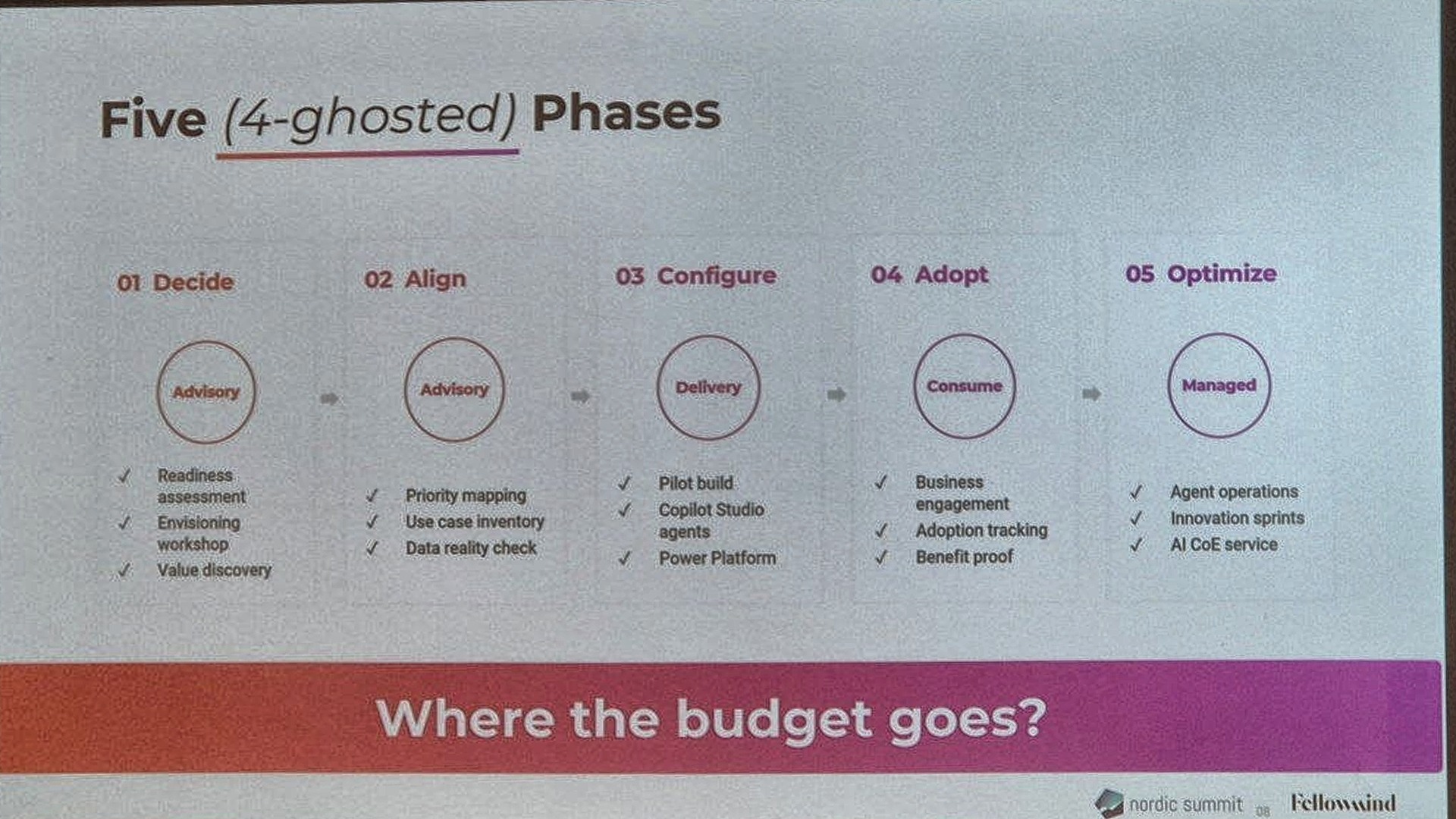
Two more warnings belong here. Do not ignore the cost trajectory: his real-world example went from MVP through extension and stabilisation to expansion at eleven times the cost, with value rising too, and an organisation that has not committed to that curve kills the agent just before the value arrives. And prioritise combined specialisation over silos: a team that covers several areas, business, technology and data, had three times the success rate of a single-specialism team in the figures he showed.
The antidotes
The tools were simple on purpose. Start with a discovery canvas, which he tied to Microsoft’s Cloud Adoption Framework: business objectives first, then data challenges, agent use cases, governance and risks, success criteria. Nobody in the room had heard of it. Understand risk and control before the money question, because money always speaks first and then stops. Score use cases on impact against feasibility, and be willing to take a quick win over the strategic path that is easier to sell. And prefer a pilot to a proof of concept: a POC proves technology, and if you already trust the technology, a pilot with a real business outcome has a far higher chance of becoming a production product.
Then the pilot card, his one-page way to describe, compare and inventory initiatives before any decision. The example he showed:
| Pilot card | |
|---|---|
| Agent name | Predict equipment failure before it happens |
| Business owner | Operations director, named person |
| Supporting roles | IT, data analyst |
| Success metric | 10% reduction in unplanned downtime |
| Timeframe | 60 days, with a stop date |
| Guardrails | Internal data only, no external models |
| Next decision gate | Results reviewed with the COO |
The line under it was the one he wanted people to remember: the stop date is the field that matters, because no end date means no decision.
The product, and the worst process award
The last five minutes were the sponsor part: Hive AI, Fellowmind’s tool for running agents as a workforce, with a skills inventory that captures how your most advanced Copilot users work and shares it, an agent lifecycle from idea to retirement, and one inventory of every agent with its owner and status. He was explicit that it is not meant to overlap with Agent 365 but to sit on top of it.
He finished with a show of hands for the worst process award. Does your agent’s data live in a spreadsheet? Are your use cases undocumented? Is the owner unclear? Do you not know what the agent costs? Nobody admitted the spreadsheet. Almost everyone admitted the cost. And the last item on the list was the one he called his favourite: just add AI.