
AI in business applications often sounds abstract until you see where it removes real work.
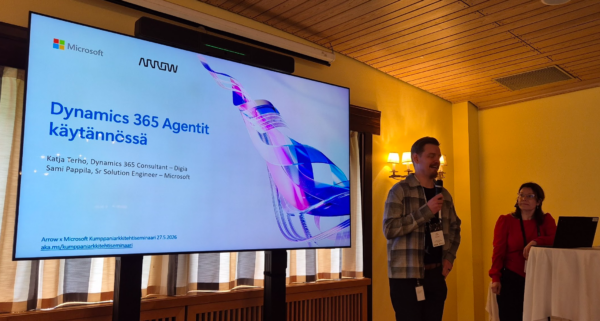
I attended Microsoft partner architect seminar in Hilton Kalastajatorppa. I had one session about developing Copilot Studio agents with Claude Code and then I participated other sessions. In the session “Dynamics 365 Agents in Practice”, Sami Pappila (Microsoft) and Katja Terho (Digia) focused on exactly that: what first‑party Dynamics 365 agents actually do inside sales and customer service processes—and where they create measurable impact.
This wasn’t about future visions. It was about what is already possible today.
From Concept to Practice: AI Inside Business Processes
One of the key takeaways is that Dynamics 365 is positioning itself as an AI-native business platform.
Instead of adding AI on top, agents are embedded directly into core processes:
- Sales
- Customer service
- Field service
- Finance and operations
This means AI is not just assisting users—it is actively participating in the workflow itself.
For partners and customers alike, the shift is important:
AI becomes part of how work gets done—not a separate tool.
The Real Use Case: Sales Qualification Agent
The most concrete example in the session came from a real implementation shared by Katja Terho.
The challenge was familiar:
- Leads were coming from marketing automation
- Quality varied significantly
- Sales spent time on low-value opportunities
The solution: Sales Qualification Agent.
What the agent does in practice:
- Reviews incoming leads automatically
- Filters out low-quality leads
- Prioritizes the most relevant opportunities
- Initiates first contact when needed
This directly impacts the sales process:
✅ Less manual lead processing
✅ Faster response times
✅ More consistent qualification
✅ Better pipeline quality
And ultimately:
More time spent on deals that actually matter.
Where the Business Impact Comes From
What makes this interesting is not the automation itself—it’s where it happens in the process.
The early stages of sales are typically:
- High volume
- Manual
- Inconsistent
This is exactly where agents deliver the most value.
For example:
- The agent can send the first response instantly → no waiting for sales availability
- Lead qualification becomes standardized → no variation between sellers
- Low-potential leads can be handled automatically or deprioritized
These are small changes individually—but together they reshape the entire pipeline.
From Manual CRM to Living Data
Another practical benefit highlighted was how agents improve data quality.
In many organizations:
- CRM updates are delayed
- Data is incomplete
- Insights require manual reporting
With agent-driven updates:
- Activities can be captured automatically
- Suggested updates are provided to users
- CRM reflects reality in near real-time
This unlocks something previously difficult to achieve:
A CRM system that is actually trusted as a source of truth.
Customer Service: Scaling Without Losing Experience
Although the demo focused on sales, the same principles apply to customer service.
Agents can:
- Handle incoming requests across channels (chat, email, etc.)
- Perform initial triage and classification
- Guide customers toward self-service when appropriate
- Route only complex cases to human agents
The key idea is not to remove humans—but to make sure they focus on:
- High-value interactions
- Complex problem-solving
- Customer experience differentiation
Configuration Over Development
One important point that lowers the adoption barrier:
These agents are not heavy development projects.
They are:
- Configured directly in Dynamics 365
- Based on existing data models
- Adjustable with business rules and criteria
For example:
- Define what a “high-quality lead” is
- Set criteria for when a lead is handed to sales
- Decide how much autonomy the agent has
This shifts the conversation:
From technical implementation to business decision-making.
The Important Questions Before You Start
Before deploying agents, the session highlighted a few critical questions:
- What defines a qualified lead in your business?
- At what stage should sales take over?
- What should be automated vs. human-controlled?
- How much autonomy are you comfortable giving to AI?
These are not technical questions—they are operational decisions.
And that is exactly why many organizations find this challenging.
Measuring Impact: From Activity to Revenue
A major advantage of embedding agents directly into Dynamics is visibility.
Because everything happens inside the platform, you can:
- Track how leads move through the pipeline
- See which deals were influenced by the agent
- Measure conversion improvements
- Attribute revenue impact
This is critical for one reason:
AI moves from experiment → to something you can actually prove.
Final Thoughts
Dynamics 365 agents show what happens when AI moves from experimentation into operations.
The biggest shift is not technological—it’s structural:
- Sales processes become more consistent
- Customer interactions become more scalable
- Data becomes more reliable
- Decisions become more data-driven
And perhaps most importantly:
AI starts working inside the business—not just alongside it.
For organizations already using Dynamics 365, the opportunity is immediate.
For partners, this means a shift:
- From configuring systems
- To redesigning how business processes actually work
Because in the end, the value of AI is not in the agent itself.
It’s in how it changes the way work flows.