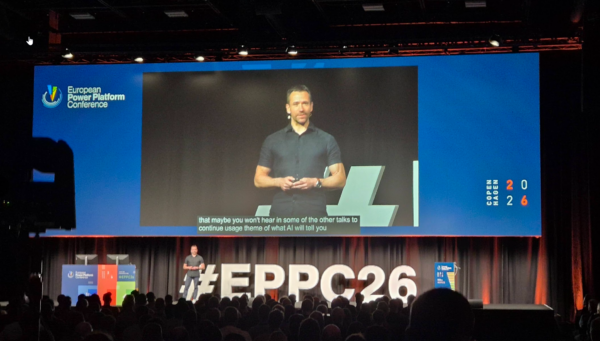

European Power Platform Conference, Copenhagen | Thursday, July 1, 2026 | Afternoon Keynote
If Nirav Shah’s morning keynote was about governing the agents you’ve already built, Chris O’Brien’s afternoon session was the harder conversation: what happens to the careers, the platforms, and the business models of the people in the room when AI gets good enough to do most of their work?
O’Brien — CTO at Advania UK — opened not with a product roadmap but with a historical pattern. Electricity, the bicycle (“bicycle face” was a genuine medical diagnosis coined when cycling became popular), the car (Iowa had a law requiring someone to walk in front of each motor car with a lamp to warn horses), and comic books (psychiatrists testified in front of the US Senate that they caused juvenile delinquency). Every new technology produces fear, resistance, and legislation. AI is no different — except it is different in one fundamental way.
Every previous technology accelerated human work. This one does human work.
How We Got Here
O’Brien walked through the economic architecture of the modern internet to explain why AI has the leverage it does. The dominant platforms — Google, Meta, Microsoft, Apple — each built a flywheel that makes their position self-reinforcing. Google collects user data that attracts advertisers that fund better search that collects more user data. Meta built a network effect so powerful that leaving it destroys your social graph. Microsoft built an ecosystem of developers and partners. Apple locked in users through device convenience and integration.
These flywheels are hard to beat from the outside. Microsoft famously spent $100 billion on Bing and still only captured 4.7% of the search market — a figure Satya Nadella cited in a court deposition. Being second in a flywheel business is almost impossible.
What changed everything was the attention mechanism — the 2018 “Attention Is All You Need” paper that enabled transformer models. Combined with scale, this produced LLMs, and then Claude Code. The shift from AI-as-autocomplete to AI-as-agent — a system that operates a browser, reads documents, writes and runs code, and handles long multi-step tasks — is what turned a research curiosity into a structural threat.
The benchmark O’Brien referenced: an independent evaluation of 220 professional tasks across industries, where human experts blind-grade AI output against human output. 83% of those tasks are now performed at least as well by AI as by a qualified human professional. The frontier labs may be hyping the future, but that number describes the present.
The SaaS Pocalypse
The market found out in a hurry.
When Anthropic launched Claude Code as an agentic AI capable of taking on extended software development work, investors and analysts started asking an obvious question: what happens to all the software that’s priced per seat and built on the assumption that humans use it?
The companies that sell project management, legal workflows, marketing automation, CRM, and HR tools — tools that exist because humans need to track work across a company — face a genuinely new threat. If AI agents can do much of that work, the per-seat model collapses. $285 billion was wiped off the software market in 48 hours following a cascade of announcements — Claude Code, Anthropic’s industry-specific plugins, and OpenAI’s Frontier Agent. Nothing like it had happened in the history of software markets.
O’Brien showed deathbyclawed.com — a tongue-in-cheek but pointed website that analyzes SaaS companies’ survival prospects in an AI world. Pick Atlassian (down 71% at the time of the talk), and the site explains why a $50B business built around ticket tracking is structurally vulnerable when AI can manage and close tickets. The site even generates a markdown file that would replace the company’s entire product. Chris said he is “62% a bot” according to the sister site that analysed his LinkedIn profile.
The SaaS apocalypse has partially reversed — markets are messy and some of these companies have adapted or rebounded. But the structural pressure hasn’t gone away. Adobe, Workday, Atlassian, DocuSign, HubSpot — O’Brien named them as companies where the market is still saying the risk is real.
What keeps a company safe from AI disruption:
- Being a distributor — owning the channel between other software and users, so nothing AI does changes who the intermediary is
- Network effects — a platform where leaving destroys your connections (Meta, LinkedIn)
- Specialist domain depth — tools so embedded in a specific regulated workflow (legal, finance, healthcare) that replacing them requires domain training AI doesn’t have
- Cash — funding the AI infrastructure buildout that smaller competitors cannot
Salesforce’s response was instructive. Rather than defending the human-facing screens, they’re opening the entire platform as a headless ERP/CRM — publishing every API and building an agent framework so that agents in any technology can call into Salesforce without needing a human in a browser. The bet: if agents are going to do the work, be the system of record the agents talk to.
The Boardroom Questions
O’Brien has had the same conversation with senior leaders across dozens of organisations. The questions in every boardroom right now are the same:
- Does AI change our business model and how we make money?
- If we’re a consultancy and a project that took 80 days now takes 8, can we still charge 80 days’ worth?
- Does AI open new service opportunities, or does it enable AI-native competitors to undercut us?
- Can we do the same work with fewer people?
The last question is the one everyone is thinking but fewer are saying out loud. It is, O’Brien noted, one of the most common questions in boardrooms right now.
For Microsoft partners and tech service firms, there’s a parallel question: if their clients are shifting all their AI spend to Anthropic, OpenAI, Microsoft, and the hyperscalers, how does the ecosystem capture some of that value? The old model of selling implementation hours is under pressure when AI collapses implementation timelines.
Is Microsoft Still a Good Home for Your Career?
Charles Lamanna — Microsoft’s EVP accountable for Dynamics, Power Platform, and Copilot Studio — has said publicly that “the age of business apps is over.” O’Brien quoted this directly. The implication: the thirty-year era of forms, workflows, and data screens built for humans to operate is ending. Agents, not users, will drive an increasing share of enterprise systems.
This has real consequences for Microsoft’s business model. E3, E5, per-user Power Apps and Power Automate licensing — all of this depends on human seats. Satya Nadella acknowledged on the last earnings call that Microsoft is shifting every per-user business toward a per-user + consumption model. The price of Copilot Co-Work is as high as it will ever be; the company expects to optimise and reduce it over time as models improve.
Contrast that with Anthropic and OpenAI, both currently operating at significant losses (OpenAI loses approximately $12.8M per employee per year) and widely expected to raise prices significantly after any IPO or profitability event.
Microsoft’s structural advantages:
- Distribution: 3.7M organisations on Microsoft 365, over 445M paid seats
- App surface: Word, Excel, PowerPoint, Teams, SharePoint — where work gets done
- Identity: Entra is the dominant enterprise identity platform globally
- Enterprise data: M365, Azure, SharePoint, Dataverse hold most of the world’s business data
- Trust: organisations maintain a “trusted boundary” with Microsoft that SaaS vendors outside that boundary often cannot cross
- Ecosystem: a global partner and developer community that vibe-coding startups cannot match
- Cash: enabling moonshots (Quantum, nuclear energy investments) and AI infrastructure buildout
- Reinvention: Microsoft’s track record of pivoting entire company strategies when markets shift — Windows to Office to Cloud to AI — is genuinely unique over 40+ years
The answer to “is Microsoft still a good home for your career” is: yes, but only if you move up.
Where to Move
For Power Platform professionals specifically, O’Brien’s advice:
Be part of the enablement engine. The value isn’t always in building the app or agent — it’s in enabling others to do it at scale, with guardrails.
Run the Centre of Excellence for agents. Business users will create agents. Those agents will need to mature: evaluation, data tuning, security review, optimisation. That’s expert work.
Build with AI, not alongside it. If you’re still building Canvas Apps the traditional way, switch to Code Apps, learn to build with GitHub Copilot or Claude Code, and understand the full range of tools available.
Elevate to solution architecture. Is this problem best solved with a Power App, a Foundry agent, a screen-based app, or a conversational interface? Being the person who answers that question correctly is high-value work that AI cannot easily replicate.
Climb to FinOps and ROI. Someone needs to answer: are we getting a return on this AI spend? Are our consumption costs optimised? Those conversations require both technical and business understanding.
Skills and Behaviours to Develop
O’Brien closed with four behaviours he’d recommend regardless of role:
Cross the streams. Technical people need to understand how executives think about AI investment and ROI. Business leaders need to get their hands dirty building agents — otherwise “use more AI” stays a slogan and never becomes a strategy.
Manage your information diet. His recommendations: The Economist‘s AI coverage (dry but grounds you in the real-world economic impact), the Dwarkesh Podcast (mandatory in Silicon Valley for understanding where the frontier is going, including Anthropic and OpenAI), and Ben Evans’ What Matters in Tech.
Automate something high-value in your own role — now. Don’t wait for someone to redesign your department around AI. Find the most valuable thing you can automate and do it yourself, then take that story upward.
Connect yourself to the business. Understand how your organisation makes money, what risks keep leadership up at night, and make yourself the person at the centre of rewiring that part of the business with AI. If you can both understand the business need and deliver the AI solution, you are more valuable than you have ever been.
Takeaway
The EPPC crowd has spent two days learning the mechanics of agents: how to build them, how to evaluate RAG pipelines, how to govern them. O’Brien’s contribution was to put those mechanics in context.
The platforms, the skills, and the business models that this community built careers on are genuinely changing. That is not a reason to panic — it’s a reason to move. The organisations that will do well are the ones with distribution, trust, and ecosystem. Microsoft has all three. So does the partner community around it.
But none of that matters if individual practitioners don’t climb above the work AI is already doing. The window to position yourself as the person who understands both the technology and the business it serves is open now. It probably won’t stay open forever.
Session: “From Boardroom to Build Room on Microsoft” — EPPC26, Copenhagen, July 1, 2026
Keynote speaker: Chris O’Brien, CTO at Advania UK