
AI is moving fast. Faster than most organizations can comfortably absorb.
I attended Microsoft partner architect seminar in Hilton Kalastajatorppa. I had one session about developing Copilot Studio agents with Claude Code and then I participated other sessions. In the session “Azure AI – current state and what’s happening right now”, Sakari Nahi (CEO, Zure) didn’t try to predict the future. Instead, he grounded the discussion in what we’re actually seeing today across organizations building with Azure AI.
And the reality is both exciting—and surprisingly messy.
Massive Investment, Unclear Outcomes
One of the first things highlighted was the sheer scale of investment.
We are talking about trillions being poured into AI globally, with a significant portion going into infrastructure and capacity building.
At the same time:
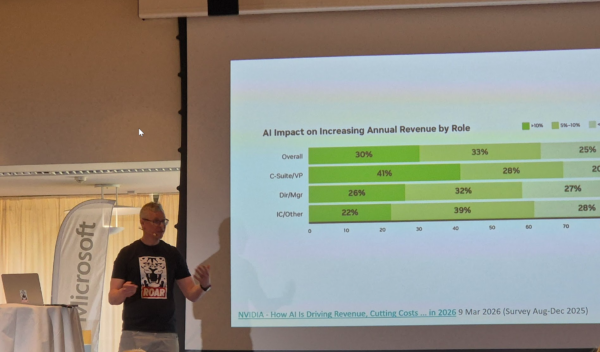
- Executives strongly believe AI will impact revenue significantly
- Many engineers and practitioners are still more skeptical
- Economic indicators don’t yet clearly show large-scale impact
In other words:
AI is clearly important—but the real business impact is still uneven and emerging.
The Key Insight: Start from Business Value
Despite all the noise around models, tools, and architectures, one message stood out clearly:
Start with business use cases. Always.
Instead of debating:
- Which model to use
- Whether to adopt a specific architecture
- Or how to structure your AI landing zone
The recommendation is simple:
- Identify where AI creates real, measurable value
- Then design everything else around that
A practical example shared:
- Environmental data analysis that normally takes months
- AI can collect, combine, and summarize data from multiple sources
- ROI becomes obvious when scaled across many similar cases
This is the difference between experimentation and impact.
From Simple Assistants to Multi-Agent Systems
What’s changing rapidly is the complexity of solutions.
A year ago, organizations were asking for:
- Chatbots
- Simple AI assistants
Now they are asking for:
- Multi-agent architectures
- Systems that combine multiple data sources
- Solutions that directly impact business processes
These architectures often include patterns like:
- Supervisor agents routing tasks
- Specialized agents for different systems (ERP, billing, etc.)
- Shared context (“blackboard”) where agents collaborate
The key takeaway:
AI systems are starting to resemble traditional solution architectures—just with agents added to the mix.
Azure Architecture: Less New Than You Think
One of the most reassuring insights from the session was this:
AI architectures are not fundamentally new.
They are still:
- APIs
- Data sources
- Application layers
- Integration patterns
The only real additions are:
- Language models
- Vector data
- New ways of interacting with systems
Even the much-discussed AI Landing Zone is often just:
- A standard application landing zone with a few additional components
Which means:
If you already understand cloud architecture—you already understand most of AI architecture.
Governance Is Becoming the Real Challenge
As organizations move beyond experiments, governance becomes unavoidable.
Some of the key challenges highlighted:
- How do you monitor thousands of agents?
- How do you control costs across multiple models?
- How do you ensure output quality?
- Who is accountable when AI makes a mistake?
There is no universal answer yet—but every organization is being forced to define:
- Their governance model
- Their risk management approach
- Their standards for quality and compliance
And importantly:
AI does not remove responsibility—someone is always accountable.
The Shift in Development Work
One of the most interesting parts of the session was how AI is changing development work itself.
We are seeing a clear shift:
- AI handles repetitive tasks (tests, migrations, bug fixes)
- Developers focus on higher-value work
- Productivity increases—but so does the need for validation
However, there’s also a critical reality:
- AI produces output confidently—even when incorrect
- Teams must verify both plans and code
- Quality assurance becomes even more important, not less
A strong recommendation was:
Build validation and testing first—then build the AI solution.
So Where Are We Right Now?
If we strip away the hype, the current state of Azure AI looks like this:
- Organizations are actively experimenting—and increasingly deploying real solutions
- Use cases are shifting from simple assistants to business-critical processes
- Architectures are evolving toward multi-agent systems
- Governance is becoming the biggest bottleneck
- Best practices are still evolving—and sometimes contradict each other
And perhaps most importantly:
The direction is clear—but the exact path is not.
Final Thoughts
What makes this moment interesting is not that AI is new—it’s that it’s becoming real enough to matter, but still uncertain enough to require careful thinking.
For architects and software companies, this means:
- Don’t wait for perfect clarity—it won’t come
- Don’t over-engineer upfront
- Focus on value, iterate, and learn
Because right now, the gap is not in technology.
It’s in turning potential into actual business impact.