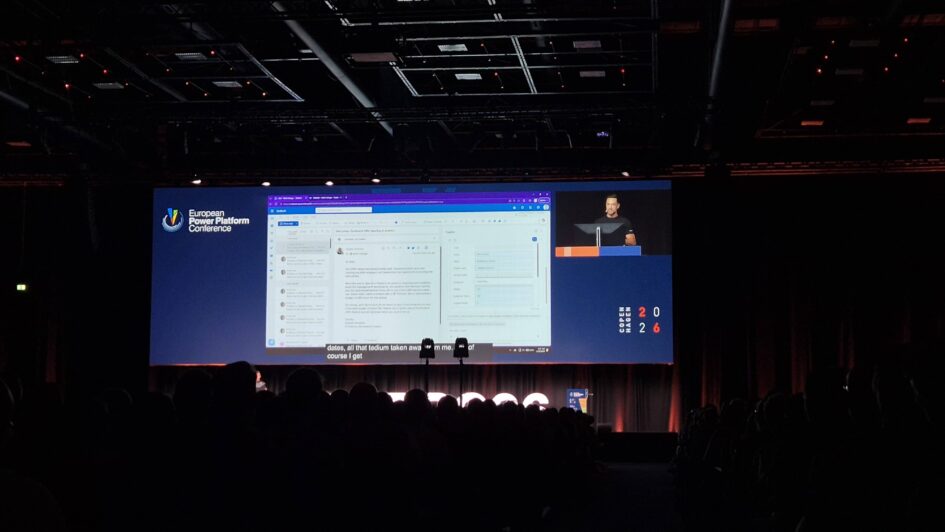
European Power Platform Conference, Copenhagen | June 30, 2026 | Opening Keynote
Ryan Cunningham opened EPPC26 with a keynote that set the tone for the entire conference: Power Platform and Copilot Studio are no longer just tools for automating tasks — they are the infrastructure for a new era of enterprise AI. The message was clear: make every person more effective, make every process better, and tackle entirely new problems that were never solvable before.
A Platform That Has Come a Long Way
The keynote opened with a live demo of Power Apps in Outlook — a time sheet application that reconciles meeting calendar data with project hours using natural language. No context switching, no manual copying. The full app experience, including grids, forms, and drill-down views, embedded directly in Outlook as a sidecar.
Ryan’s summary captured it well: “That was not your uncle’s Power Apps.”
The point was broader than a single demo: Power Platform solutions can now surface anywhere users already work — in Copilot chat, as Outlook sidecars, or inside custom agent experiences. The same apps and their underlying data and logic are available wherever users need them.
The New Copilot Studio
The headline announcement of the keynote was a public first-look at the new Copilot Studio — rebuilt from the ground up with a fundamentally different architecture.
What changed under the hood:
The old model of writing static prompts and calling specific models for specific tasks is giving way to something more powerful. Modern agents now run in their own container — a virtual environment that can reason, adapt, use tools, hold a plan, and recover from deviations. This is the same architecture that powers GitHub Copilot coding agents and Microsoft’s own internal agents.
What’s new in the experience:
– Skills — reusable packages of capabilities that tell an agent how to use its tools. If you find yourself writing the same paragraph of instructions across multiple agents, that’s a skill trying to get out.
– Model choice — select the right model per agent or even per skill, balancing powerful reasoning for hard problems with fast, efficient responses for routine ones.
– Workflows + agents together — workflows are no longer just automation; they orchestrate how agents work together. An agent can call a workflow as a tool; a workflow can invoke an agent at exactly the right step. Predictable and controllable by design.
– Evals — the new quality system for makers. Not just “does it work the first time,” but a rubric for continuously improving agent quality over time. Every failure in production becomes a new eval case.
– Monitor tab — full visibility into every production run: every tool called, every knowledge source used, every decision made.
The live demo showed a bid evaluation workflow: an email triggers classification, attachments go to an evaluation agent, a researcher agent checks vendor background, and a final recommendation agent posts a summary to Teams — all without a single line of traditional code.
Governance Is Not a Tax
Ryan spent significant time on a theme that echoed through the keynote: at scale, governance is not a constraint — it’s what makes scale possible.
Microsoft’s own internal numbers illustrate the pace of change:
– 800,000+ Power Apps inside Microsoft
– 1,000,000+ Power Automate flows
– ~600,000 agents — most of them built in the last few months
“We built all those apps and flows over the better part of the last decade. We built most of those agents in the last few.”
That rate of growth creates real pressure on governance and oversight. Ryan highlighted Agent 365, now generally available, as the tool for managing what agents are doing at scale — and called out that Microsoft itself uses managed environments, environment routing, and personal developer environments to keep its own platform under control.
Customers Doing It at Scale
Two customer examples stood out:
KONE — the elevator and escalator company featured prominently in Ryan’s slides. Starting from 3,000 makers, the company has built over 30,000 Power Apps and is now bringing AI directly into the flow of their work — combining unstructured SharePoint documents, structured SAP data, and AI agents to process 50,000+ service contracts automatically.
Government of Flanders — managing 18 billion euros in annual public grant funding with a team of five auditors responsible for 6,000 high-risk recipients. Manual review took 15 minutes per invoice. With Copilot Studio agents and workflows: 6 seconds. And instead of sampling, they now audit everything.
Graebel — a global talent mobility company that has automated 75% of accounts payable processing and is deploying teams of agents to replace entirely manual, email-based contract management.
The Learning Loop
Ryan closed with a framework for thinking about where all of this leads. The same learning loop that drives improvement in an individual agent project — build, test, evaluate, improve — scales to the entire organization:
- Make every person more effective with tools like Copilot
- Take every existing process and enhance it with Power Platform and AI
- Tackle new problems and invent entirely new processes with Copilot Studio agents and workflows
- Do all of it on a governable, observable, auditable platform
“This is the type of creativity that we all need.”
Key Takeaway
EPPC26’s opening keynote was a statement of direction, not just a feature announcement. The convergence of apps, flows, agents, and AI in a single governable platform is not a future vision — it’s what’s shipping now. For organizations invested in Power Platform, the message was simple: everything you’ve already built is the foundation for what comes next. The ceiling has moved.
Opening Keynote: “Building What’s Next for Work” — EPPC26, Copenhagen, June 30, 2026
Speaker: Ryan Cunningham, Microsoft