
Since 8 September our orchestration repository has collected over 900 commits. Every one of them is a rule, a script or a fix for a team of Claude Code sessions that run on a cloud server and hand work to each other. In a LinkedIn comment in October I described it as “three Claude Code sessions in ssh tmux that hand work to each other”. It has grown a bit since then.
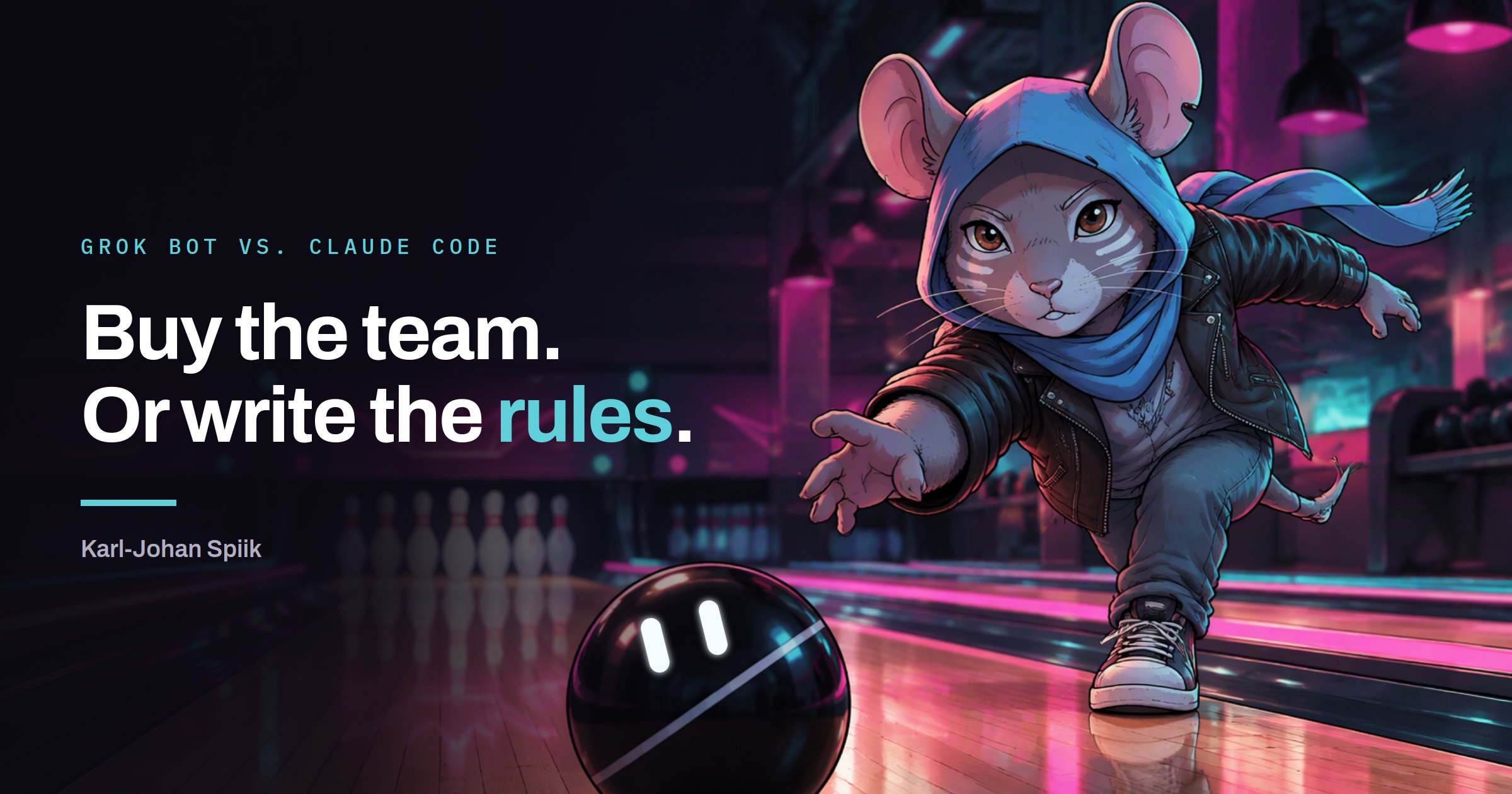
Grok Bot, which SpaceXAI (renamed SpaceXSI in October) opened as a beta on 11 August, sells the same idea as a product. A Chief of Staff Bot can coordinate specialist Bots, each Bot has its own computer in the cloud, and the team keeps working when your laptop is closed. So the obvious question is why anyone would write over 900 commits of rules when they could just install the thing.
I have not used Grok Bot. These tables compare structure, based on what SpaceXAI and VentureBeat have published. SpaceXAI published no benchmarks at launch, so nobody can compare performance.
Two ways to get an agent team
| Grok Bot | Our orchestration | |
|---|---|---|
| What it is | Commercial beta product | Our own system on Claude Code, on a cloud VM |
| Who coordinates | Chief of Staff Bot over specialist Bots | One session hands out work, helpers do it, a planning session writes the rules |
| How work moves | Bots message each other and pass ownership in threads | A work queue in a database, and a dispatcher starts a separate process for every job |
| Scheduling | Proactive Bots and scheduled routines | Cron runs the dispatcher, reminders live in the same database |
| Model | Automatic router, no documented way to choose | Chosen per task: a larger model plans, a smaller one does mechanical work |
| Apps without an API | Each Bot clicks through apps on its own cloud computer | API or MCP first, UI work on one shared machine with a booking lock |
The first rows look alike. The difference is in how work moves. In Grok Bot the Bots agree between themselves who owns what. In our setup a job is a row in a queue, and the result goes into the project’s log file in Git. The next session reads what the previous one did instead of remembering it.
Where the rules live
| Grok Bot | Our orchestration | |
|---|---|---|
| Learning a routine | Watches you do it once, saves it, takes corrections | I say it, and a planning session writes it down as a rule |
| When to ask a human | The Bot decides when to ping you | A written list: deletions, anything sent out, production, changes to how a process works |
| Memory | Remembers your style and conversations | Project logs in Git and a lessons database where every row has a source and a date |
| Guardrails | Not described in the launch material | Hooks that block permanent deletes and check for customer names before text leaves |
| Audit trail | Not described in the launch material | Every job leaves a log line and a commit |
This table is where the two really part ways. Grok Bot learns by watching and decides for itself when something needs you. SpaceXAI says the Bots “only come back when something needs your approval”. That is the whole promise of the product, and it is also the place where it can go wrong. VentureBeat noted the flip side: the same features that let Bots act on their own and coordinate with each other “expand the consequences of an incorrect assumption, stale context or improperly scoped permission.”
Ours works the other way round. An agent stops at every boundary that nobody has opened in writing. If a session wants to delete a file that is not pushed, a hook stops it and asks me. If it wants to send an email, it writes a draft and I press send. Nothing is learned by watching, and that is slower. But when something goes wrong, I can read the rule that allowed it and find the commit that added it.
What it costs to start and to keep
| Grok Bot | Our orchestration | |
|---|---|---|
| Getting started | Install it and show it the work | Building it is the work: over 900 commits since September |
| Price | Comes with plans such as Cursor Ultra at $200 a month or Cursor Premium Teams at $120 a seat (VentureBeat). Bot usage is counted separately from the plan’s own usage | Claude subscription, a cloud VM and my own time |
| Upkeep | The vendor’s job | Mine: a new situation stops the work until there is a rule for it |
| Where your data is | The Bot’s cloud computer | Our own VM and our own repositories |
| Maturity | Beta, no published benchmarks | In daily use, with rules that grew out of things that broke |
Matt Shumer, who tested it with a researcher and a writer Bot under a Chief of Staff, wrote on X that “it worked out of the box” (quoted by VentureBeat). That first row is the honest reason to buy. Our first row is ten weeks of building, and the upkeep row never ends. Every time something new happens, an agent stops and asks, and the answer becomes a rule.
Many people think building your own is only for those who enjoy it. I think the choice comes down to what happens when the agent is wrong. If your work is a handful of routines in apps that have no API, and a mistake costs you ten minutes, Grok Bot is the faster road. You show it, it runs. If the agent touches customer data, keeps two work contexts apart, or can send something in your name, then you want to know why it did what it did. Then the written rule is worth what it costs to write.
Grok Bot is ahead in two places
The first is a computer per agent. We have one machine with a screen, and when two jobs need a browser, the second one waits. The second is teaching by showing. Today I tell our system what to do and a session writes it as a rule. Doing a browser task once and letting a session save the steps would be faster than describing them. Neither is built. Both would change how the system works, so for now they are ideas on a list, not plans.
But a customer who has tried Grok Bot told us the Bots are not very bright. The instructions have to stay narrow, or they get lost. That matches the model row in the first table: Grok Bot picks the model for you through an automatic router. In our setup I choose the model for each task, so the work stays precise and I don’t have to worry about giving an agent too much information.
What I would not take is the Bot deciding when to ask. That decision is the one thing I want to have made myself, in advance and in writing.
Our agents get the keys the job needs and nothing more
Grok Bot leaves the question of when to ask to the Bot. We answer it ahead of time with permissions. In episode 4 of Armandiel AI we show how we do it: why an instruction that says “don’t” is weaker than a permission the agent never had, how an agent can read mail without being able to send it, why delete goes only to the trash, and the key mistake we made ourselves. Watch What should your AI be allowed to touch? Accounts, keys and permissions and find the rest of the series on Armandiel AI.