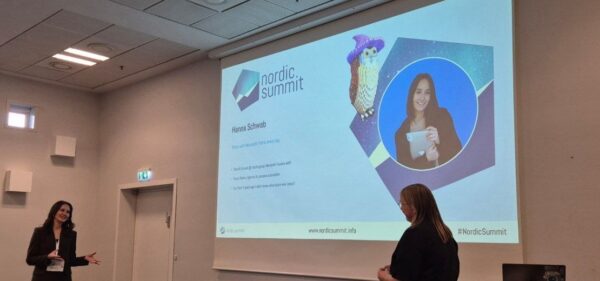
The most unusual format I saw at Nordic Summit 2026 was Sandra Kiel and Hanna Schwab on “You Don’t Need to Know Everything to Start: A Real Path Into Data with Microsoft Fabric”. Sandra is a game designer, an MVP and managing director of her own company focused on gamification in the Microsoft world, and she had never used Fabric. Hanna leads the data and analytics team at teccle group and works with Fabric daily. The session was Hanna teaching Sandra, live, with the audience watching someone ask the beginner questions out loud. This is my recap. The session is theirs, the summary and any mistakes are mine.
The confidence gap
The frame for the session was what Sandra called her confidence gap, and she was explicit that it was hers, not Hanna’s. They asked the room what it feels like to start with a new tool, and collected the answers: a new vocabulary to learn, no idea where to begin, cost and licensing, and time, because you can spend three days investigating a tool only to find it was not the one you needed. Someone added the frustration of failing at the very start.
Four causes on the slide: too many options and features, no clear starting point, fear of asking basic questions, and giving up after one try. Overcoming that gap was the stated goal of the session, and they promised to check at the end whether it had moved.
Just enough architecture
Hanna’s teaching approach was to give the smallest mental model that lets you start. Fabric is Microsoft’s software-as-a-service platform for everything data and AI, and its purpose is one place where the different sources are consolidated and validated so that reporting, forecasting or AI has a foundation. You do not need to understand every feature at once.
OneLake is the central storage where everything lands, structured, semi-structured or unstructured. When Sandra asked whether that is what used to be called a data warehouse, the answer was a useful distinction: a lakehouse holds diverse content and you work with it in Python or Spark, a warehouse gives you strict schema enforcement for reporting, and you do not have to choose, because both live in Fabric. On top sit the workloads, Data Factory, analytics, databases, real-time intelligence, Fabric IQ and Power BI, and Power BI being inside Fabric is what makes it feel familiar rather than new.
The nesting model, which is the part beginners get wrong: a tenant holds capacities, a capacity holds workspaces, a workspace holds items like lakehouses, warehouses and semantic models, and items hold objects like tables and views. You can exchange data between workspaces, but not across separate capacities.
Is Fabric even right for me?
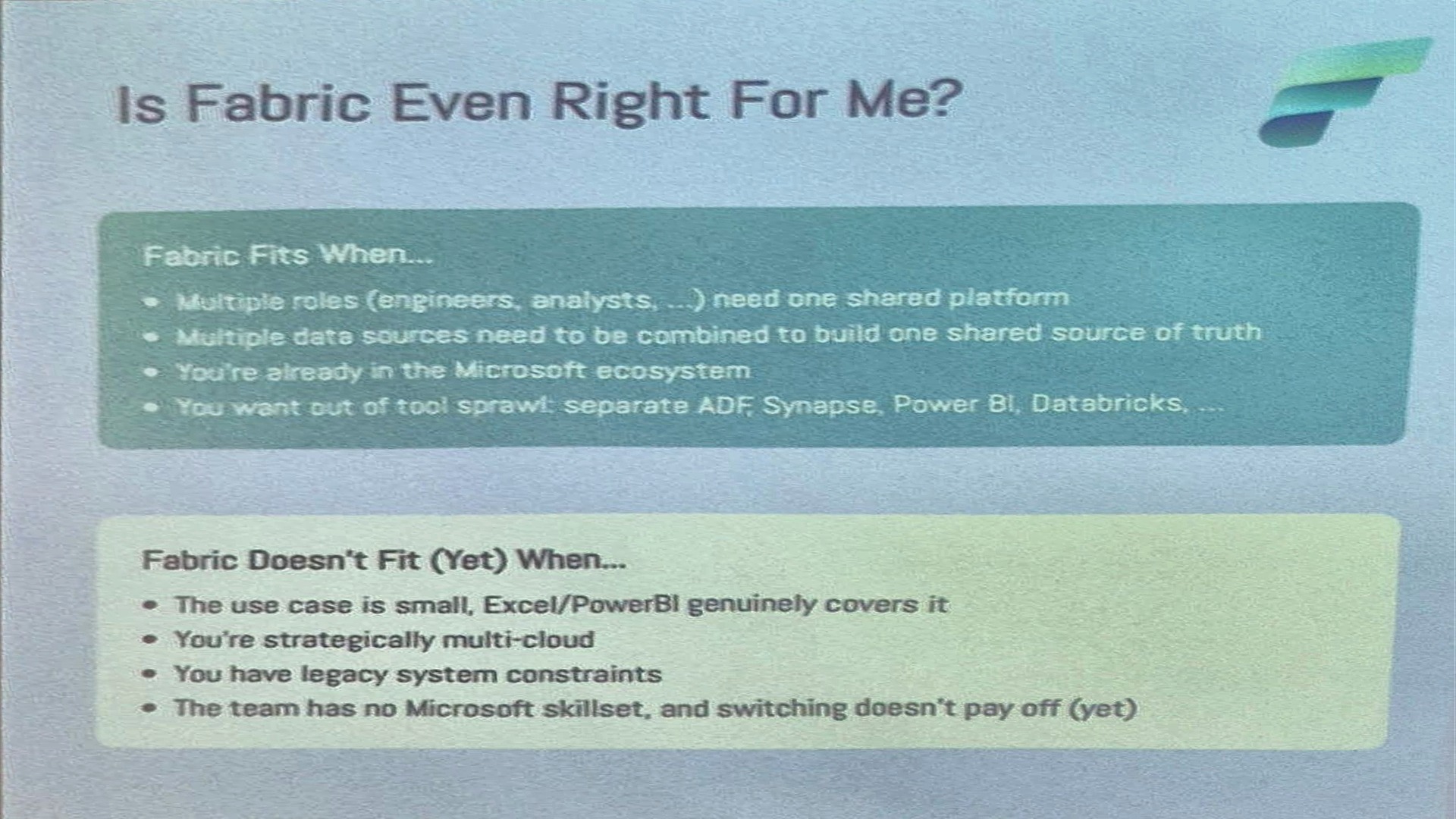
| Fabric fits when | Fabric doesn’t fit (yet) when |
|---|---|
| Multiple roles (engineers, analysts, …) need one shared platform | The use case is small and Excel or Power BI genuinely covers it |
| Multiple data sources need combining into one shared source of truth | You’re strategically multi-cloud |
| You’re already in the Microsoft ecosystem | You have legacy system constraints |
| You want out of tool sprawl: separate ADF, Synapse, Power BI, Databricks | The team has no Microsoft skillset and switching doesn’t pay off yet |
They tested it with three cases and a show of hands. A monthly Power BI report for a 40-person sales team with many roles: yes, and the reason someone in the room gave was governance, because otherwise you get Version Final and Version Final Final of the same spreadsheet. One data scientist merging CSV files by hand in Python for three hours a day, with nobody else ever touching the data: no, that is unnecessary overhead and there are lighter tools. A retail chain that has to redo the same work over and over on fresh data: that is the shape Fabric is for.
Sandra’s challenge was the right one. The single source of truth problem is not new, she said, it is the same problem every disconnected system has always had, so it is not special to Fabric. Hanna’s answer was to turn it back: if it is not a new problem, are you still as afraid of the tool as you were? She was not.
What a capacity actually is
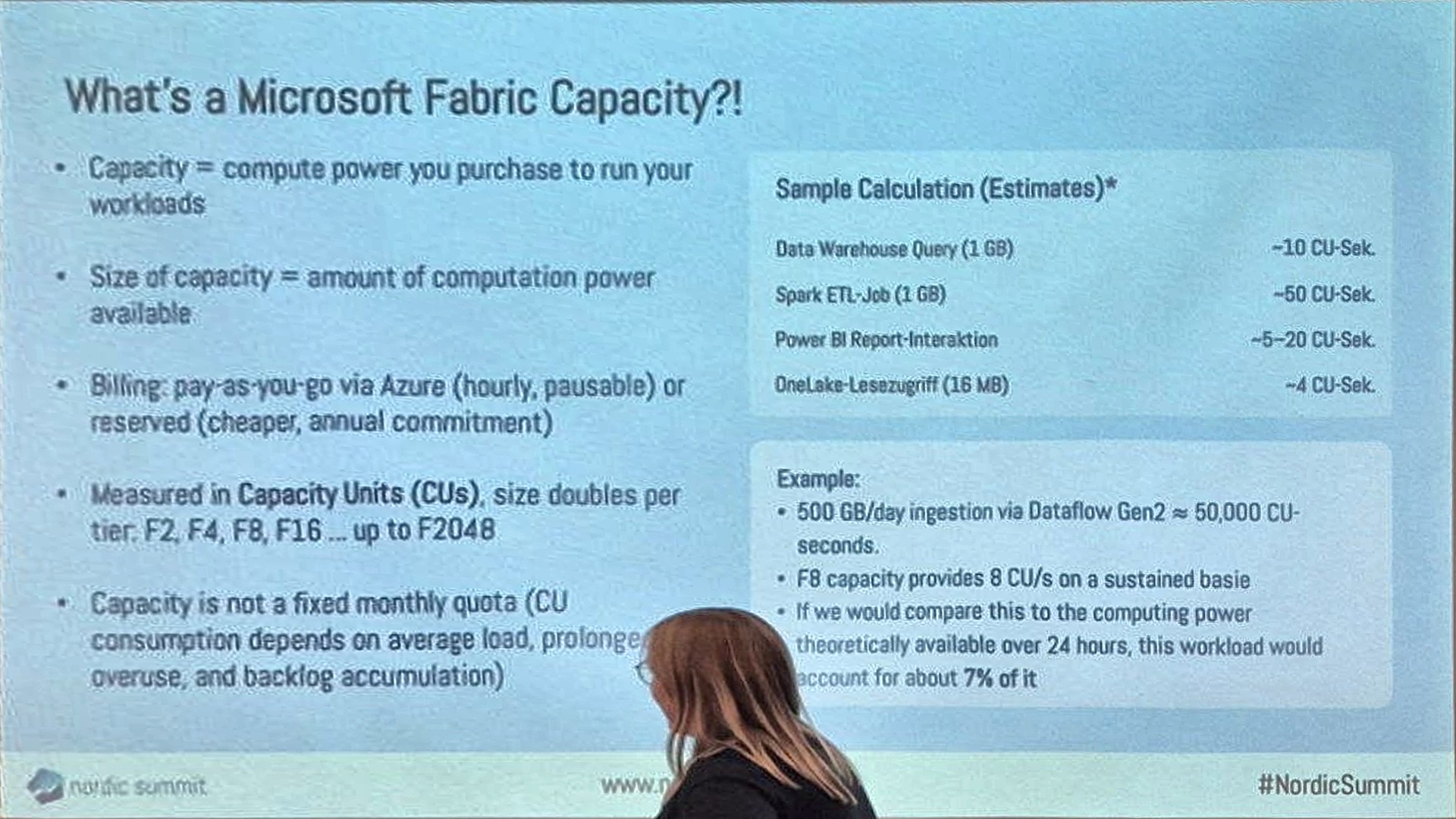
Capacity is the compute you buy to run your workloads, measured in capacity units, doubling per tier from F2 upward, billed either pay-as-you-go through Azure (hourly, pausable) or reserved with an annual commitment. It is not a fixed monthly quota: consumption depends on average load, prolonged overuse and backlog.
Hanna’s practical advice: start most beginner use cases on the smallest capacity, which is where she starts her own projects, and scale up when the compute is not enough without moving the workload. Sandra’s analogy was the one that made it land for the room: it is like running Minecraft at 20 frames per second, fine until you fight another player. And yes, you can scale back down.
Breaking Fabric, live
The demo was the point of the format. Sandra drove, Hanna guided, and the dataset was the Eurovision Song Contest, to answer how often Denmark has won. They walked the medallion architecture as folders: bronze for raw data, silver for transformed, gold prepared per use case. Sandra created a folder, deleted it because it broke Hanna’s naming convention, created a lakehouse, and then in the silver layer opened a prepared dataflow and promptly deleted one of the applied steps. Nothing was lost, which was the lesson: the applied steps list shows exactly what was done, and you can put it back.
Then they added a filter to keep only years from 2000 onward, which Sandra recognised as the same thing she does in Excel, saved the dataflow and watched it run. In the gold layer they built a data agent: new item, add a data source, pick the semantic model, select the tables, and ask a question in natural language. Who has won the most times? Sweden. The agent showed its steps and the DAX query it had written, which is the part that turns a black box into something you can check. A follow-up asking for a pie chart of wins by country was still running when time ran out.
The closing exchange was the honest one for a session about starting. It is not that hard, Hanna said, which is the reaction she gets from clients once they try it. The rest of the slides they had prepared were left for download, because the room wanted to watch someone break things instead.